













Neither the Buddha Nor You
The stories Mark tells at the Potala Palace — Ludongzan’s fate, two rival princesses, and the Sixth Dalai Lama’s poem
Published 13 August 2026 · 18 min read
- WherePotala Palace · Medicine King Hill · Lhasa
- Stops10 + the poem
- Read18 minutes
- Told byMark, your guide
The story, stop by stop
- 1 · On the bus — before we arrive
- 2 · Medicine King Hill — the viewpoint
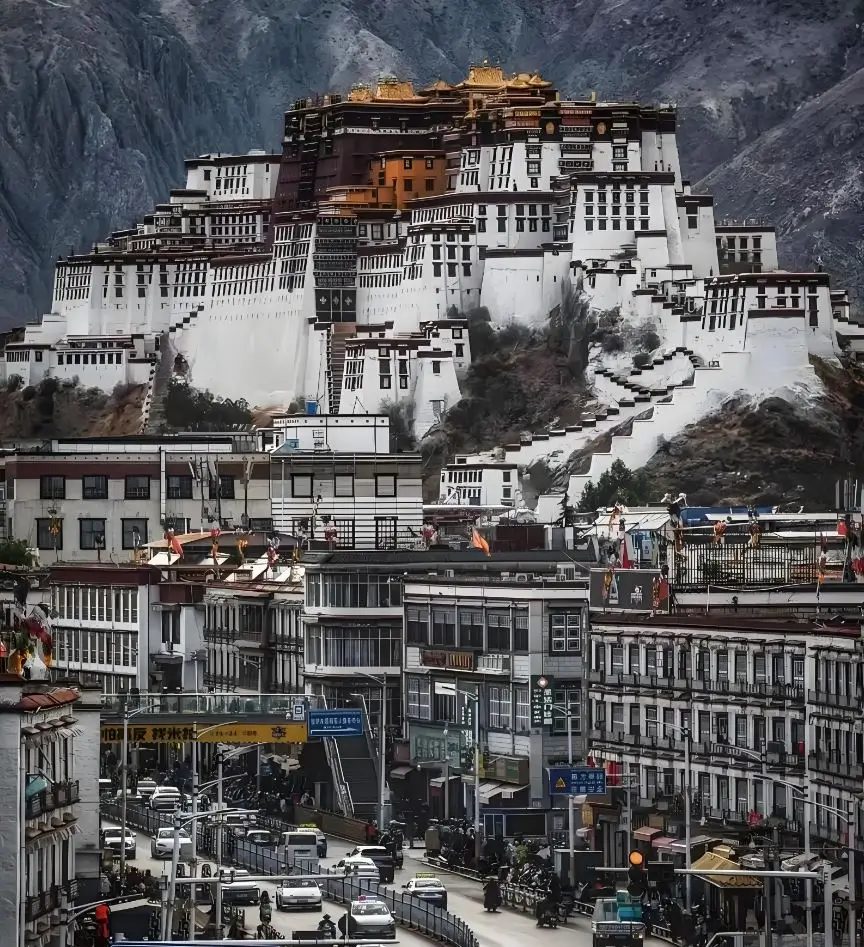
- 3 · The building on the hill — and why the walls look so new
- 4 · Ludongzan — continued from Jokhang Temple
- 5 · The black mole — and what it meant
- 6 · Two princesses — do not confuse them
- 7 · Princess Jincheng — five queens and one baby
- 8 · The feast — the baby decides
- 9 · The white stupas — mending what was cut
- 10 · Before we go in — the Sixth Dalai Lama
- The Poem
On the bus — before we arrive
“Good morning,” I said, stepping onto the bus and finding my footing.
“Good morning,” the group answered.
Today we visit what you have been waiting for since you arrived in Lhasa — the Potala Palace. Everyone connects the Potala to the Dalai Lama, and that connection is real. But before the Dalai Lama lineage existed at all, there was already a palace on this hill. The hill is called the Red Hill. And the hill directly opposite it — which we visit first — is called the Medicine King Hill. I will explain both.
Our order today is different from other groups. First, the best position for photographs. Then the Potala Square. Then inside. Follow me.
Medicine King Hill — the viewpoint
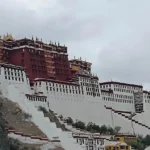
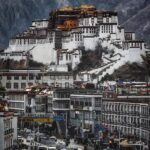
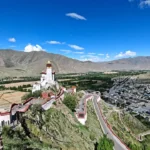
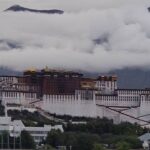
Here we are. The best position in Lhasa to photograph the Potala Palace.
Mark: “Anybody have a 50-yuan note on them?”
Group member: “I have one.”
Mark: “May I borrow it for just a minute? One hundred percent returning it to you — no worry.”
Group member: “Sure.”
Take the note and flip it to the back. Look at the image printed there. Now look up at what is in front of you.
This is where that photograph was taken. You are standing on the back of China’s fifty-yuan note.
Fifteen minutes for photographs — find your angle, take your time. When everyone is done, come back here. I will tell you about the building on the Red Hill, the hill we are standing on now, the two princesses who changed both of them, and the Dalai Lama who could not stop writing poems.
The building on the hill — and why the walls look so new
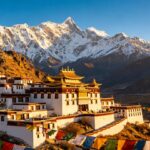
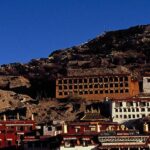
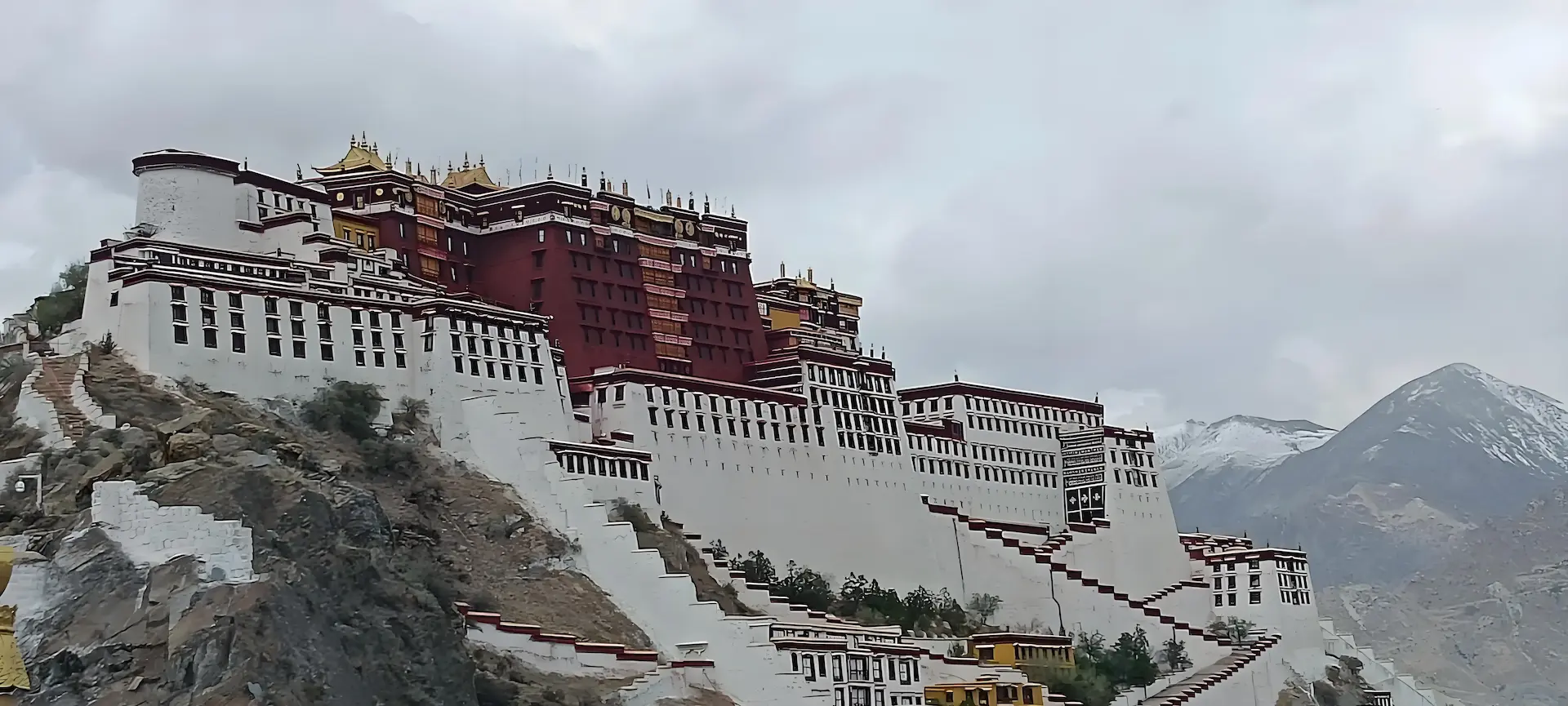
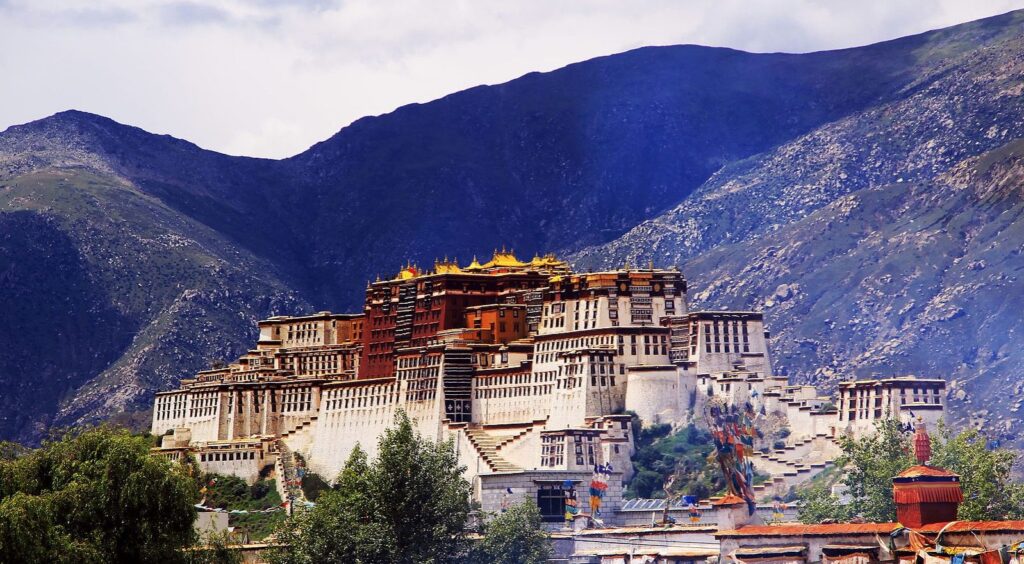
The great structure in front of you stands on the Red Hill. As early as the seventh century AD, when Songtsen Gampo moved the Tubo capital to Lhasa, the royal palace was placed here. The royals lived above. Ordinary people gathered around Jokhang Temple below — and old Lhasa grew outward from there, which is what you saw when we walked the Barkhor.
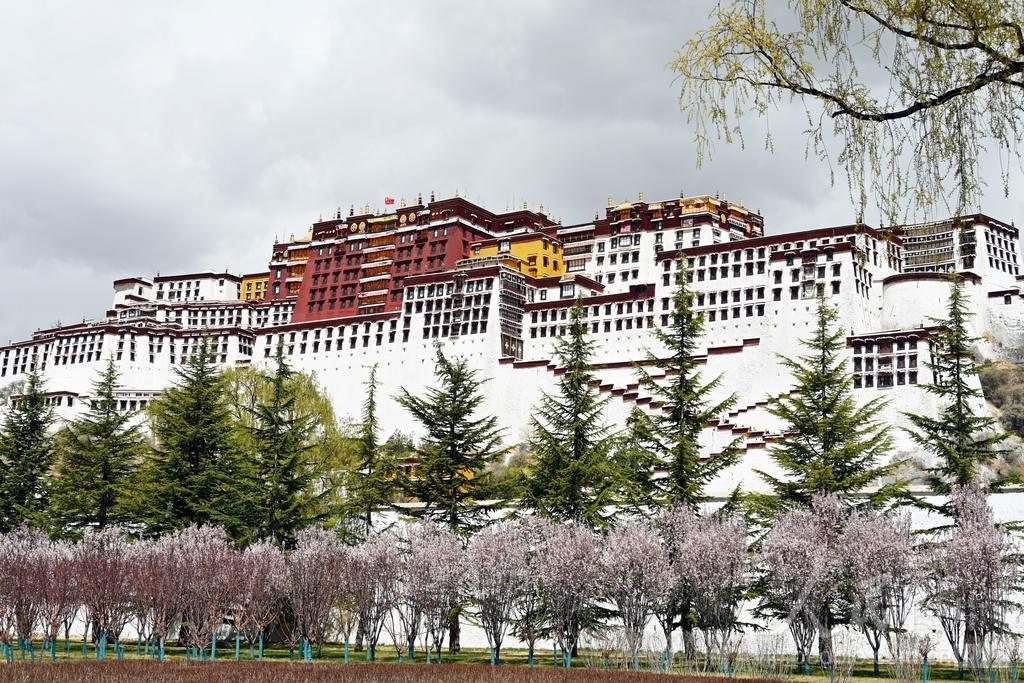
But a word of caution: the Potala Palace you are looking at now is not the seventh-century palace. The building in front of you was rebuilt in the seventeenth century, under the Fifth Dalai Lama. What Songtsen Gampo originally built has not survived.
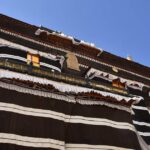
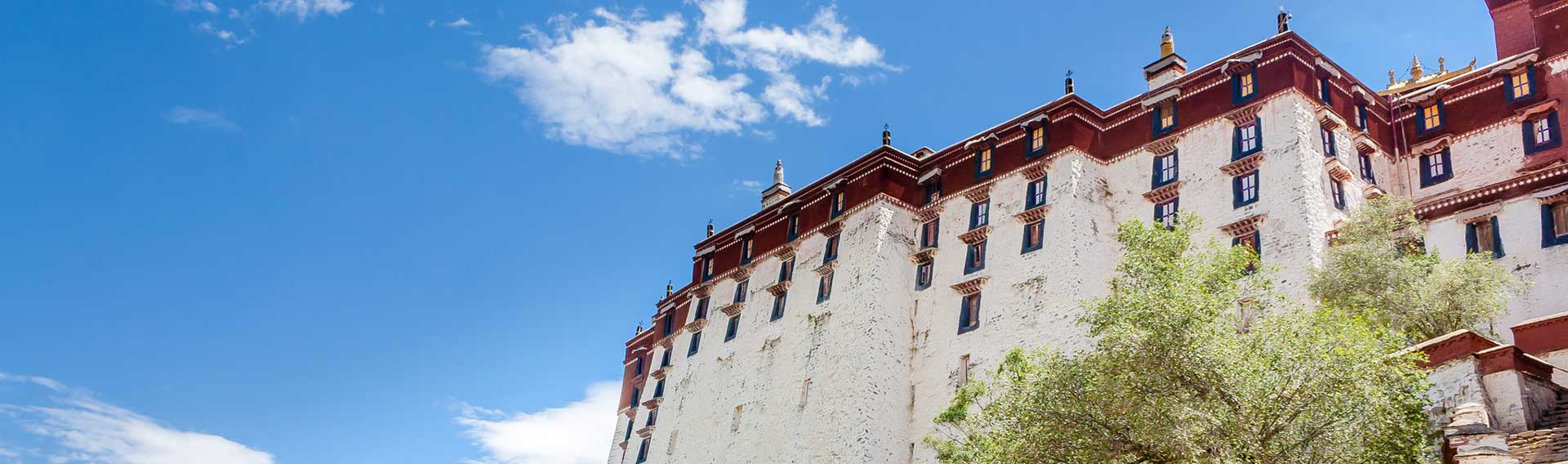
And the walls — they look freshly painted, don’t they? They are. Lhasa has a tradition of repainting the exterior every few years. The white and the dark red you see today are not thirteen centuries old. They are a few years old, at most.
Ludongzan — continued from Jokhang Temple
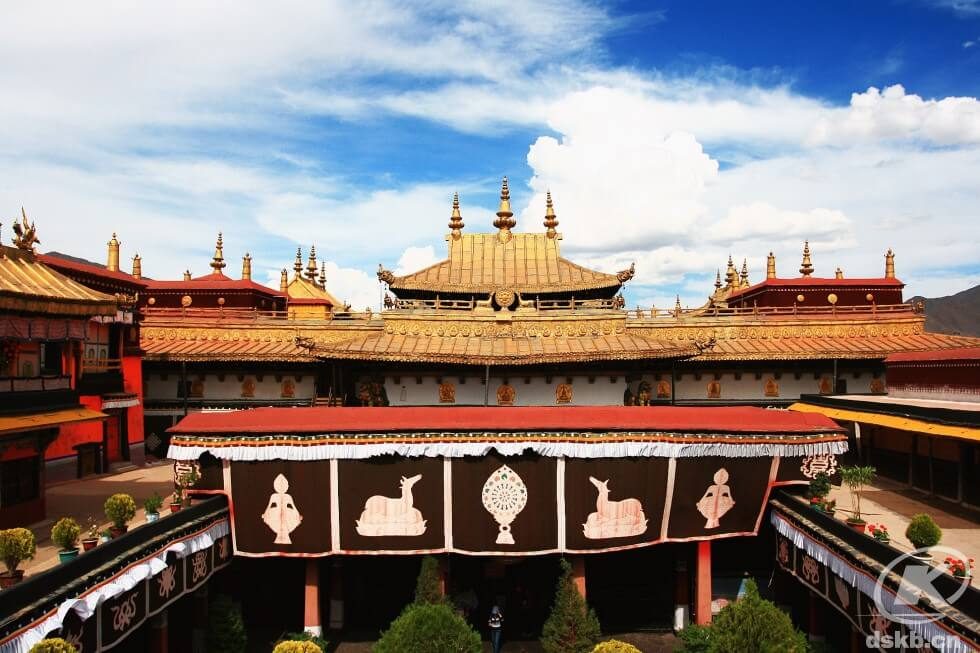
At Jokhang Temple, I told you about the man Songtsen Gampo sent to the Tang court — his most trusted minister, Ludongzan. The nine-curving pearl. The ant tied with a silk thread. The honey at the other end. He solved every test and won Princess Wencheng for Tibet.
What I did not finish at Jokhang is what happened after.
The journey from Chang’an to Lhasa took four years. Princess Wencheng’s party set out from the Baqiao Bridge — the same bridge whose willow seedlings she brought to Jokhang — and traveled west through what is now Gansu Province, then through Qinghai, crossing the plateau step by step, in every season, at altitude. Four years on the road. The same small group of people, the same long silences between one mountain range and the next.
Ludongzan led the escort the entire way.
The black mole — and what it meant
When the party arrived in Lhasa, Ludongzan did not bring Princess Wencheng before the king directly. Instead, he presented a portrait.
There was a political calculation behind this. If Songtsen Gampo saw her in person and was not pleased — or found himself simply indifferent — he would be in a difficult position. She was not an ordinary woman he could treat carelessly. She was a princess of the Tang dynasty. To neglect or mistreat her would invite consequences that would outlast any personal feeling. A portrait gave everyone time.
On the portrait, there was a black mole on her face.
For a period after the party’s return, the king did not seek out Princess Wencheng himself. He had seen the portrait. Life in Lhasa continued.
Then one day he came across her — in a corridor, a courtyard, somewhere in the ordinary course of things. He stopped and asked: who is this woman?
The people around him told him: this is Princess Wencheng, the princess from the Tang court.
He looked at her, and then looked again. There was no mole.
Here the official history ends and the folk history begins. The gap between the portrait and the woman — a mole that was painted but not real — is where the story lives. What is widely told in Tibet is this: over four years on the road, through mountain passes and empty plateau, the minister and the princess had grown close. Feelings had developed. Some versions say a child was born between them during that long journey. Marking the portrait was the only thing Ludongzan could do with something he was not allowed to keep.
When Songtsen Gampo understood what had happened, Ludongzan’s end was a tragic one.
That is the story I promised to finish at the Potala. You now have it in full.
Two princesses — do not confuse them
Many visitors to Tibet mix up two different Tang dynasty princesses who each came to Tibet in different eras. They are separate people with completely separate stories, and each story belongs to a different location. Let me make the distinction clearly, because the rest of today depends on it.
Princess Wencheng — her story belongs to Jokhang Temple and Barkhor Square. The geomancy reading. The demon woman lying face-up across the land of Tibet. The pond, the white goats, the name of the city. The Jowo Shakyamuni statue. The willow tree. That is Wencheng’s territory, and we have already covered all of it.
Princess Jincheng — her story belongs here, to this hill and the Red Hill opposite. The white stupas between them. The severed dragon vein. These are Jincheng’s stories, and we have not told them yet.
Jincheng arrived a full generation after Wencheng, during the reign of King Tride Tsuktsen. She brought with her a large collection of medical texts from the Tang dynasty. Those texts became one of the foundations of what we now call Tibetan medicine — which brings me directly to this hill.
This hill — Yutuo Yundan Gongbu and the birth of Tibetan medicine
The Medicine King Hill is not a decorative name. This is where the founder of Tibetan medicine studied, worked, and conducted his experiments.
His name was Yutuo Yundan Gongbu. He was born into a medical family and entered the royal palace as a court physician at the age of ten. He later traveled — to India, to Nepal, to the Tang dynasty — studying the medical traditions of each place, absorbing everything he found, and bringing it back to the plateau. He combined what he had learned with the specific conditions of high-altitude life and created a complete, independent system: Tibetan medicine.
You will often hear Tibetan medicine described through five diagnostic methods: observation, smell, questioning, pulse — and urine examination. That last one surprises most visitors. Urine diagnosis is the signature technique of Tibetan medicine, described in its founding texts and still practiced by traditional Tibetan doctors today. If you ever consult a Tibetan physician, expect it.
Ancient Tibetan records say Yutuo Yundan Gongbu lived to more than 130 years old. Whatever the precise number, what he left behind is not in dispute: the Four Tantras — the foundational text of Tibetan medicine, sometimes compared to China’s Huangdi Neijing . Medical students in Tibet still study it as primary text today.
He wrote it on this hill.
Princess Jincheng — five queens and one baby
Now back to Jincheng and her story.
King Tride Tsuktsen had five queens: three were daughters of local Tibetan noble families, and two were foreign princesses. Jincheng was one of the two. Of all five queens, only Jincheng bore the king a son — the child who would later become the celebrated King Trisong Detsen, the ruler who invited Guru Rinpoche to Tibet and formally established Buddhism as the state religion.
The moment the child was born, a noblewoman of the Nanam clan — one of the other queens — seized the baby and declared him her own. Jincheng had no recourse she could exercise. She grieved. Every day, she wept.
Then, in fury, she raised a sword and cut the connection between the Red Hill and this hill — the Medicine King Hill. In the cosmological thinking of the time, the point where two hills meet is the dragon vein — the artery of the land’s vital energy. To sever it was not a private act of destruction. It was a declaration, public and irreversible: something has been broken here, and the king must respond.
The king responded.
The feast — the baby decides
Tride Tsuktsen arranged a settlement feast. Tang dynasty envoys were invited as witnesses. The Nanam family sat on one side of the hall. Princess Jincheng and the Tang delegation sat on the other. The child was placed between them.
Then both sides reached for the child and took hold of his arms — each pulling toward their own side.
The Nanam woman pulled hard. She was there to win.
Jincheng pulled too — and then stopped. She felt the child’s small arm in her hands and thought of what might happen to it. She let go.
She could not do it. Even at that moment, with everything at stake, she could not make herself use force on him.
The king watched this, and then made his ruling: let the child decide for himself.
The Nanam side immediately arranged their case — candies, pearls, bright toys, the kind of things that catch a small child’s eye and draw his hands. Everything that should work. Jincheng’s side offered nothing.
The child looked at none of it. He crossed the hall and went to Jincheng, carrying in his hands a small bowl of barley wine.
This is what 母子连心 means — the hearts of mother and child are joined by something that cannot be named and cannot be argued against. It spoke from both directions at once. Jincheng had let go of his arm because she would rather lose than see him hurt — that is the mother’s side of the bond. And the child had walked past every bright and sweet thing toward the one person who offered him nothing — that is the child’s side. No candy reaches it. No pearl competes with it. It is simply there, between a real mother and her child, and the whole hall saw it in the same moment.
The boy was returned to Jincheng. He grew up to become Trisong Detsen — one of the most consequential kings in Tibetan history.
The white stupas — mending what was cut
After the feast, when the matter was settled and the emotion had passed, Jincheng regretted what she had done to the land. She had severed the dragon vein in anger. The hills did not deserve that.
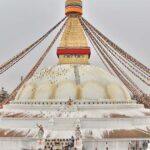
She ordered three white stupas built at the exact point where the connection between the two hills had been cut. In earlier times, the stupas were linked by silk khata scarves and coloured prayer banners stretched between them. This cluster of stupas also served as the western gate of old Lhasa — all foot traffic, all horses and carts, passed through the archways between them when entering or leaving the city from the west.
The stupas visible today are not the originals. They were rebuilt in the 1990s during the renovation of the Potala Palace Square. Notice how they are now connected: by iron chains. That is not decorative. It is symbolic — a second attempt to rejoin what Jincheng cut thirteen centuries ago. The dragon vein, sealed again in iron.
This story belongs entirely to Jincheng. Do not attach any part of it to Wencheng.
Before we go in — the Sixth Dalai Lama
We are about to enter the Potala. Once inside, the corridors are narrow and the crowd makes it nearly impossible to stop and speak at length. So I want to tell you about one person before we cross the threshold.
The full structure of the Dalai Lama and Panchen Lama lineages — how reincarnation is recognized, how the system was formalized, what the political consequences have been — I will explain in detail at Tashilhunpo Monastery in Shigatse, which is the Panchen Lama’s seat and the right context for that story. For now, just one figure from the Potala’s own history.
His name was Tsangyang Gyatso — the Sixth Dalai Lama. He was a Living Buddha who was not suited to the life. He did not want the palace, the ritual, the formal distance from the world. He wanted Lhasa — the streets, the tea houses, the warmth of ordinary people. He used to slip out of the Potala at night and walk the city alone until dawn.
One winter night, he went out and did not return until early morning. Snow had fallen during the night. His footprints — coming in from outside, leading back to his quarters — were clear in the snow, impossible to explain away. The ministers who had long opposed him used those footprints as the formal grounds for his deposition.
What happened afterward is not settled. One account says he was killed on the journey that followed his removal from power. Another says he escaped and lived for many more decades in eastern Tibet and along the Sichuan border, under a different name, until he was very old.
History did not preserve him through politics or through power. It preserved him through his poems.
The Poem
《不负如来不负卿》— Neither the Buddha Nor You
曾虑多情损梵行,
入山又恐别倾城。
世间安得双全法,
不负如来不负卿。
Once I feared that loving you would betray my monastic vows.
But if I retreated to the mountains, I would be betraying you.
Where in this world is there a way to honour both?
To be faithful to the Buddha — and faithful to you.
Tsangyang Gyatso, the Sixth Dalai Lama. The man who lived in the building now in front of you. A monk who wanted to love someone. A ruler who wanted to be ordinary. A man for whom the two greatest obligations of his life — to the dharma and to a person — could not both be kept.
The question at the center of this poem has no answer. That is why it is still read today, three hundred years later, by people who have never seen Tibet and will never stand where you are standing now.
About the storyteller
Mark
On the road since the winter of 2003 — and still guiding today. China’s retirement system says otherwise; Mark disagrees. He now works exclusively with clients who request him by name, and with TibetTravel.com’s most discerning travellers — never a common sightseeing group. He taught himself Tibetan mythology through ten volumes of fairy tales during his early years on the road, and has spent over two decades explaining these walls to astonished groups in a dozen languages.
Hear this story in person
We visit the Potala Palace on every Lhasa tour.
The 50-yuan viewpoint, the white stupas, the stories of Ludongzan and Princess Jincheng, and the poem of the Sixth Dalai Lama — all told in person, in front of the exact places where each story happened.
Frequently asked questions
What poem is this story about?
It centres on the Sixth Dalai Lama’s most famous poem, given in full English translation, along with the stories Mark tells before entering the Potala.
Why do the Potala's walls look so new?
The building on the hill — and why its walls look recently built — is one of the things explained in the story.
What else does the story cover?
It includes Ludongzan’s tragic fate, continued from the Jokhang Temple story, and how to tell the princes and princesses apart in Tibetan iconography.
We answer within 12 hours, Monday to Saturday.