



Universe in Earth and Stone
The royal tombs of a lost dynasty · The monastery built as a Buddhist cosmos
- WhereTibetan Kings Tombs · Samye Monastery · Shannan
- Stops9
- Read22 minutes
- Told byMark, your guide
The story, stop by stop
- 1 · Sky burial is not Tibet’s oldest tradition
- 2 · A necropolis two hundred years in the making
- 3 · The four tombs worth knowing
- 4 · The valley that received them back
- 5 · Tibet’s first monastery — and an unusual choice of ground
- 6 · Walking into the Buddhist universe
- 7 · The name that came from an exclamation
- 8 · The mural and the child who would build this monastery
- 9 · Full circle — and back to Lhasa
Stop One · Tibetan Kings Tombs · Chongye Valley
Yumbulakhang · Yarlung Valley · Shannan Day 1
Jokhang Temple · Barkhor Square · Lhasa
Norbulingka · New Palace · Lhasa
Sky burial is not Tibet’s oldest tradition
Ask most visitors what they know about Tibetan funeral customs and the answer comes immediately: sky burial. The body given to the vultures. The sky as coffin. It is a striking image — and not wrong. But it is incomplete. What stands before you today tells the part that is almost always left out.
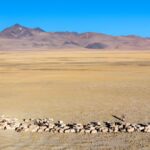
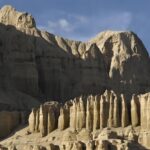
Sky burial is not Tibet’s ancient tradition. It was not how Tibet began its relationship with the dead. In the era of the Tubo Kingdom — the great Tibetan empire of the seventh to ninth centuries — the kings of Tibet did not give their bodies to birds. They were buried in the earth. Here. In this valley. Under these mounds.
A necropolis two hundred years in the making
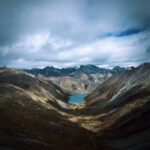
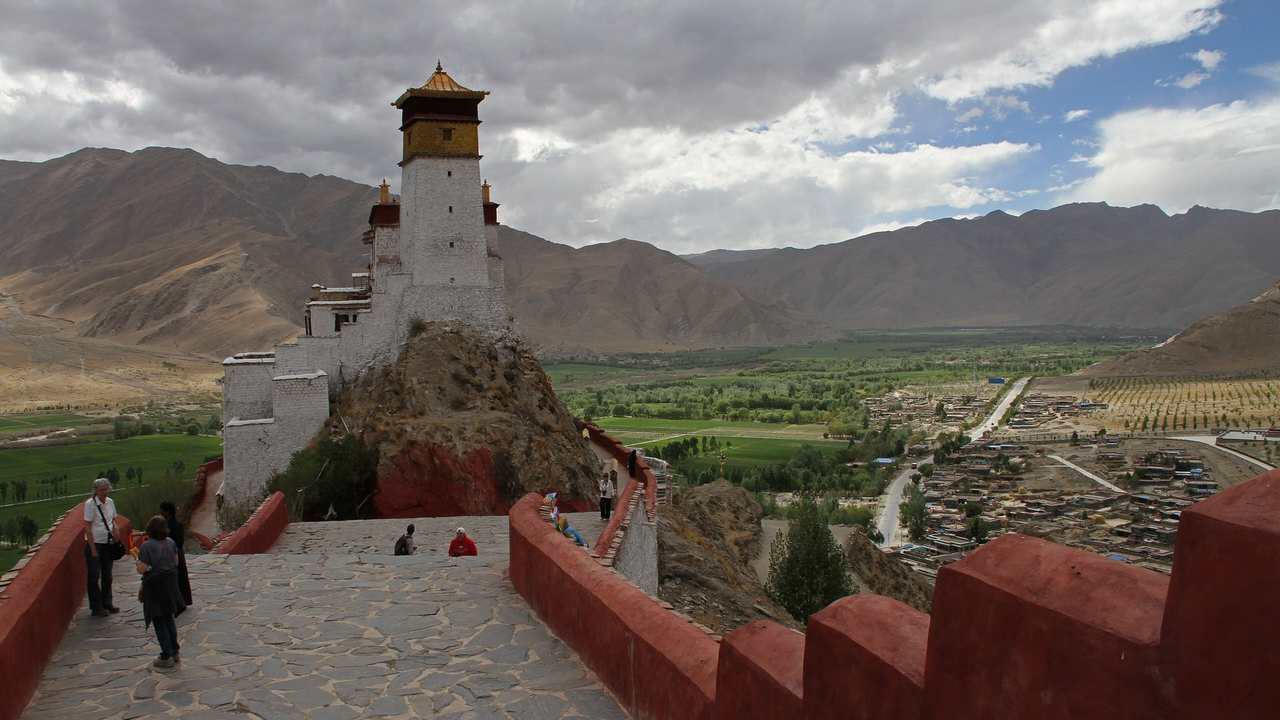
We are in Chongye County, Shannan Prefecture — in the Yarlung River valley, at the foot of a hill called Muraze. This is the Tibetan Kings Tombs: the burial ground of the Tubo Dynasty’s rulers, their queens, and their senior ministers.
The site covers approximately 3.05 million square metres. Historical records mention twenty-one burial mounds; today, sixteen to nineteen can be identified. Of these, the owners of nine have been confirmed through research. Buried here are the kings from the 29th Tsenpo of the Tubo Dynasty down to its 40th and final ruler, Langdarma — spanning two full centuries of the dynasty’s most consequential reigns.
This is the highest-altitude imperial necropolis in China, and the largest preserved royal burial site in Tibet.
The four tombs worth knowing
Four mounds stand above the rest in historical importance:
Songtsen Gampo’s tomb — the central and most famous mound in the entire necropolis. Its square earthen platform measures 140 metres on each side and stands 13.4 metres high. A small temple once crowned the summit, and beneath the mound lies an underground palace: the central chamber is a Buddhist shrine, and four corner rooms once held treasures. Tradition holds that Songtsen Gampo and Princess Wencheng rest here together. A small chapel at the base still holds their sculptures and receives offerings today.
Trisong Detsen’s tomb — the largest single mound in the entire site, its square flat top measuring 180 metres on each side. This is also the man who founded Samye Monastery — the place we will visit next.
Chide Songtsen’s tomb — notable for the stone stele standing beside it, the most famous inscription in the Kings Tombs area. The text records the king’s deeds and the events of his reign.
Langdarma’s tomb — the smallest in the necropolis, just 39 metres on a side. Langdarma was the final king of the Tubo Dynasty. After his reign, the dynasty collapsed, and the age of the earth burials ended.
What Locals Know
These burial mounds do not look like imperial tombs from other parts of China. The typical shape elsewhere is a rounded dome — sometimes a hemisphere, sometimes the broad inverted-bowl form. The Tubo mounds are different: each is square with a flat top, a shape not found in Chinese or Central Asian royal burial traditions.
They were built in layers — earth, stone, and round timber, each layer roughly seven to eight centimetres thick, with a row of wooden logs compressed between layers. The technique is not decorative. It is structural: the timber absorbs movement, distributes load, and prevents the mound from settling unevenly. After more than a thousand years, not one has collapsed. The method outlasted the dynasty that invented it.
The valley that received them back
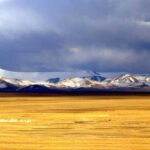
The Yarlung valley is where Tibetan civilization began. Nyatri Tsenpo descended from the mountains and was made the first king here. The fields below Yumbulakhang were the first cultivated farmland. And when the Tubo kings grew powerful enough to build an empire, they left — moving the capital northward to Lhasa, unifying the plateau, expanding east and west and south.
But they all came back here to rest.
These are not kings who chose the Yarlung valley as a convenient burial ground. These are men who built one of the most powerful kingdoms in Asia of their era — who negotiated with the Tang Dynasty as near-equals, who ruled from a capital two days’ journey away. And when they died, they were brought back to the valley where their civilization had started, and buried under the earth in which it had grown.
This is not one tomb. It is a dynasty’s complete necropolis. The flat-topped mounds you see are not ruins. They are a civilization’s record of where it came from.
Stop Two · Samye Monastery · Yarlung Tsangpo Valley
Tibet’s first monastery — and an unusual choice of ground
We have seen Tibet’s first palace, Tibet’s first farmland, Tibet’s first royal tombs. Now we come to the last of the firsts in this valley: Tibet’s first monastery that was complete in all three jewels — the Buddha, the Dharma, and the Sangha.
It is the eighth century. Trisong Detsen sits on the Tubo throne. More than a hundred years have passed since Songtsen Gampo brought Buddhism to Tibet. The religion has spread across the plateau, but it lacks something essential: an ordained Tibetan monastic community. There are scholars, translators, temples, and texts — but no Tibetan monks. The Sangha, the third of Buddhism’s Three Jewels, does not yet exist on Tibetan soil.
Trisong Detsen invited two great masters from India. The first was Shantarakshita — the scholar-monk known in Tibetan as Zhiwatso, the Peaceful Commander — a man of extraordinary learning and monastic discipline. The second was Padmasambhava, the tantric master whose story is inseparable from Tibetan Buddhism itself. Legend records that whenever construction began, spirits and demons demolished the work each night. It was Padmasambhava who subdued the forces resisting the monastery’s foundation, allowing it finally to be completed.
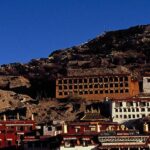
Now notice where we are standing: on a flat plain, on the north bank of the Yarlung Tsangpo River. This is unusual — strikingly so. Potala Palace stands on Red Hill. Sera Monastery is built against a mountain. Tashilhunpo rises on the slope of Drolmari. Almost every great monastery in Tibet is built against high ground. Samye stands on a plain. The reason explains everything about what this building actually is.
Walking into the Buddhist universe
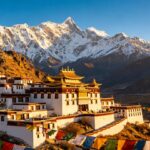
Samye Monastery was not designed as a place of worship. It was designed as a three-dimensional scale model of the entire Buddhist cosmos — a mandala built in earth and stone, large enough to walk through.
The plan follows the Buddhist cosmological scheme of the Great Thousand Worlds. Every structure in the compound corresponds to a location in the universe:
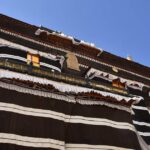
At the centre stands the Utse — the Great Hall. It represents Mount Meru, the axis of the Buddhist cosmos. The Utse has three floors, each in a different architectural style: the ground floor is Tibetan, the middle floor is Han Chinese, the upper floor is Indian. This is why Samye is also known as the Three-Style Monastery — built in the three architectural traditions of the civilised world it knew.
Surrounding the Utse in the four cardinal directions stand four temple halls, representing the Four Continents of Buddhist cosmology: the Eastern Victorious Continent, Southern Jambudvipa, Western Godaniya, and Northern Kuru. Each is flanked by two smaller halls representing the Eight Sub-continents. Two further halls represent the Sun and the Moon.
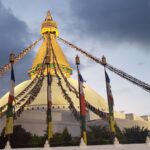
At the four corners of the central hall stand four stupas — red, white, green, and black — each colour corresponding to one of the four great events in Shakyamuni’s life: his birth, his enlightenment, his first teaching, and his final nirvana.
The entire compound is enclosed by a circular outer wall topped with 108 small stupas. The circular wall represents Iron Mountain — the ring that, in Buddhist cosmology, encircles and contains the known world.
To walk into Samye is to walk into a scale model of the Buddhist universe. That is why it was built on flat ground: a mandala needs a plain, not a mountain. The architecture is not a building containing a cosmology. The architecture is the cosmology.
The name that came from an exclamation
When the monastery was finally complete, Trisong Detsen stood before it and looked at what had been built. The accounts record that he was so astonished by what he saw that he cried out a single word.
Samye — in Tibetan, “inconceivable.” “Beyond expectation.” “This was not what I imagined.”
The monastery has carried that exclamation as its name ever since. It was not chosen in a planning meeting. It was the king’s first word when he finally saw the finished thing.
What Locals Know
Among Samye’s most significant achievements — and the reason it became Tibet’s “first monastery” in the full sense — is what happened after the building was completed. Trisong Detsen personally selected seven young men from Tibetan noble families and had them ordained as monks. These seven are known in Tibetan history as the Sad mi bdun — the Seven Awakened Men, the Seven Founding Monks.
Until this moment, Tibet had Buddhist texts, Buddhist teachers, Buddhist temples. But it had no ordained Tibetan monks. The Seven Founding Monks were the first Tibetans to enter the Sangha — the community of ordained practitioners. With them, all Three Jewels — the Buddha, the Dharma, and the Sangha — were present on Tibetan soil for the first time. This is what makes Samye the first monastery in the complete sense: not just the first building for Buddhist worship, but the first place where all three conditions were fulfilled together.
The mural and the child who would build this monastery
In the cloister corridor of the Utse, there is a famous mural. It tells the story of the man who built Samye — but it shows him as a small child, before any of it had happened.
Princess Jincheng of the Tang Dynasty had married the Tubo king Chide Songtsen and become pregnant. A jealous consort of the court, fearing the princess’s position, pretended to be pregnant herself. When Princess Jincheng gave birth to a son, the consort took the child and claimed him as her own. The boy was raised in the royal court under a false identity.
One year after the birth, King Chide Songtsen held a great banquet to celebrate the infant’s first anniversary. He filled a golden cup with highland barley wine and handed it to the child, saying: go and offer this cup to your maternal uncle.
Every official in the hall tried to attract the boy’s attention — calling to him, reaching toward him, making themselves visible. But the small child walked directly to the Tang Chinese delegation and held out the golden cup to the Han official seated there. Then he spoke:
“I am a nephew of the Tang Dynasty. How can a man of the Nanam family be my uncle?”
Princess Jincheng had found her son. And the child who spoke those words — who walked, unaided, to the right man in a room full of wrong ones — grew up to become Trisong Detsen: the king who built Samye Monastery, invited the masters from India, ordained the first Tibetan monks, and stood one day before a finished building and said: inconceivable.
The mural you see here was painted in this monastery that he built. The child in the painting is the building’s maker. The banquet in the image is the moment that secured the existence of the man who would stand, decades later, in front of all of this — and find himself without words.
Full circle — and back to Lhasa
This morning began at the royal tombs — where an empire’s greatest rulers returned, at last, to the valley where everything had started. It ends here at Samye, where a king who had been taken from his mother as an infant grew up to build a monument to all three jewels of a religion he wanted for his people.
From the first palace, to the first farmland, to the first royal tombs, and now the first monastery — the cradle of Tibetan civilization has shown you its full shape. Now we drive back to Lhasa.
See this on a tour
More stories from the Shannan journey
Frequently asked questions
What are the Tibetan Kings Tombs?
They are the royal burial mounds of the ancient Tibetan kings in the Chongye Valley — a necropolis two hundred years in the making. The story covers the four tombs worth knowing.
Why is Samye Monastery important?
Samye was Tibet’s first monastery, said to have been laid out to represent the Buddhist universe in earth and stone.
Is sky burial Tibet's oldest custom?
No — the story explains that sky burial is not Tibet’s oldest burial tradition, and how the royal earth burials came before it.
We answer within 12 hours, Monday to Saturday.