











The White Goats That Named a City
Why Lhasa is called Lhasa — and what Jokhang Temple is built on
Published 13 August 2026 · 12 min read
- WhereJokhang Temple · Barkhor Square · Lhasa
- Stops14
- Read12 minutes
- Told byMark, your guide
The story, stop by stop
- 1 · On the bus — before we arrive
- 2 · Barkhor Square — in front of the main gate
- 3 · The incense burner
- 4 · The pilgrims prostrating at the gate
- 5 · William’s question
- 6 · The Legend
- 7 · But where?
- 8 · Temple or monastery — before we go in
- 9 · Inside Jokhang — the main hall
- 10 · The Jowo Shakyamuni — the most sacred statue in Tibet
- 11 · The hollow stone — the pond is still there
- 12 · The right wall — the story painted
- 13 · On the roof — prayer wheels and prayer flags
- 14 · Out to Barkhor Street
On the bus — before we arrive
Our main stop this morning is Jokhang Temple, and after that we will walk the Barkhor circuit together. But before we get there, I want to explain something — because the temple, the street, and the name of the city you are sitting in are all part of the same story.
Lhasa. You say it: Lha-sa . But the original name was Re-sa . In Tibetan, Re means white goat. Sa means earth, or soil. White Goat Earth — that is what this city was called first. Over the centuries, through the small errors that happen every time a name passes from mouth to mouth, Re-sa became Lha-sa . Why was a city named after a white goat and a patch of soil? I will tell you when we arrive. But first, some history you will need.
In the seventh century AD, Tibet’s Tubo Dynasty under King Songtsen Gampo was extraordinarily powerful. His armies raided the Tang Dynasty repeatedly, pushing as far east as what is now Wugong County in Shaanxi Province. The Tang court, looking to secure its borders, formed an alliance with Tibet — the Tang-Tubo Alliance — and agreed to Songtsen Gampo’s request for Princess Wencheng’s hand in marriage. She left the imperial capital Chang’an carrying agricultural seeds, medicines, texts on astronomy and divination, and willow tree seedlings taken from the Baqiao Bridge just outside the city walls.
Barkhor Square — in front of the main gate
Here we are. Everyone off. Gather in front of the main gate — follow me.
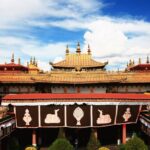
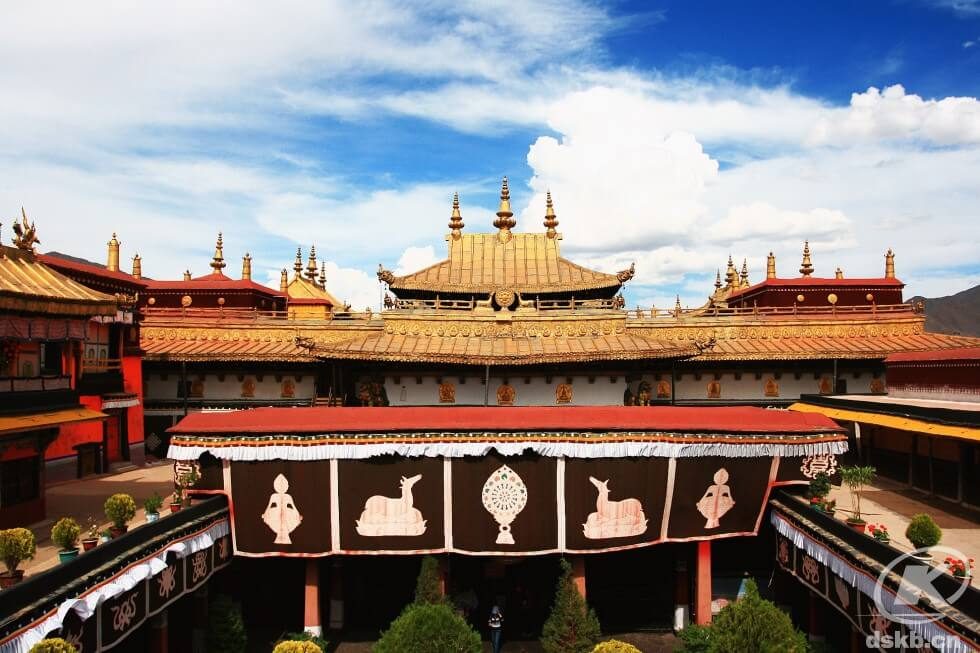
The magnificent building in front of you is Jokhang Temple. Now turn to your left. That square stone enclosure with the tall stele standing inside it — come closer. You can read three different scripts carved into the stone: Chinese, Tibetan, and Mongolian. This is the Tang-Tubo Alliance Stele, erected to mark the peace between two kingdoms.
And the dead tree standing beside it? That is — or was — one of the willow seedlings Princess Wencheng brought from Chang’an in the seventh century. You may have noticed that Lhasa has very few trees. It had even fewer then. Of all species, willow is among the easiest to grow — push a single cutting into the ground and it takes root on its own, without care, without tending. That was precisely why Princess Wencheng chose it. And yet, after thirteen centuries, even this one finally died. It never grew large, either.
Why hasn’t it been removed? Because it cannot be. This tree is a witness to the friendship between two kingdoms. That is why it still stands here, in its enclosure, dead.
The incense burner
Look at the large stone incense burner to your right. It is smoking, yes? But notice — it doesn’t actually flame. I have a question for you: why does it smoke without catching fire?
Jack: “Because of the altitude. Not enough oxygen.”
Mark: “Thank you, Jack. Good instinct. But the correct answer is that the people tending it keep it this way on purpose.”
Smoke rises. In the belief of the people who burn this incense, the rising smoke carries their prayers directly upward — into the sky, to the ears of the gods. A flame sends heat outward in every direction. Smoke travels upward. That is why it must smoke, not burn.
As you travel around Tibet, notice this: wherever people live, there is always one of these — a white stupa-shaped burner, never fully extinguished, burning a mixture of juniper, cypress, and fragrant herbs. A village may have no temple. But it will always have one of these. The fire inside never goes out.
The pilgrims prostrating at the gate
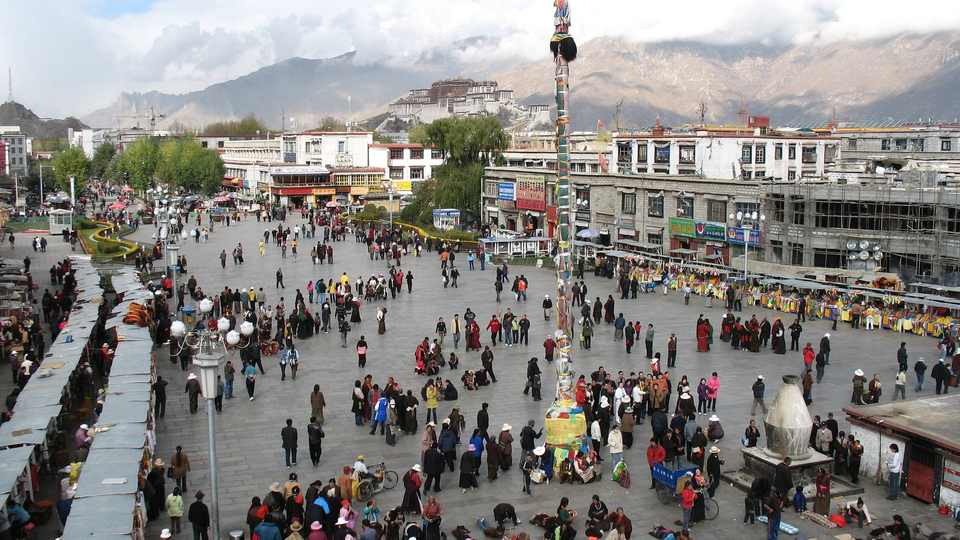
Now walk with me toward the main entrance. Look at the people on the paving stones in front of you. These are pilgrims performing full-body prostrations — hands, knees, and forehead all touching the ground simultaneously, the full body laid flat in devotion.
Some of the people you see here have been doing this since they left their home villages — thousands of kilometers away. Not walking. Prostrating. Measuring the full length of their body against the earth, standing, moving forward only to where their outstretched hands touched the ground, then prostrating again. Some for months. Some for longer.
Why? Because inside this building there is one specific statue. I will show it to you when we go in.
In Tibet, roughly 97% of the population follows Tibetan Buddhism. Among all sacred places in the world, Jokhang Temple holds the position that Mecca holds for Muslims — it is the spiritual center of the earth for every devout Tibetan. That is what those people on the ground in front of you are expressing. And many of them have come from the furthest edges of the plateau to do it.
William’s question
I paused here. William had been thinking.
William: “Mark, I feel like the Lhasa name story and what we’re seeing now have gotten a bit disconnected. We understood that Lhasa evolved from Re-sa — white goat plus earth. But what does any of that have to do with Jokhang Temple? Why start with the name when we’re here to see a temple?”
Mark: “That is an excellent question. I was just about to get there.”
The Legend
The demon woman, the swampy pond, and the white goats
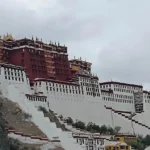
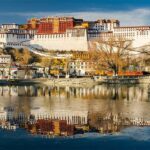
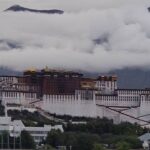
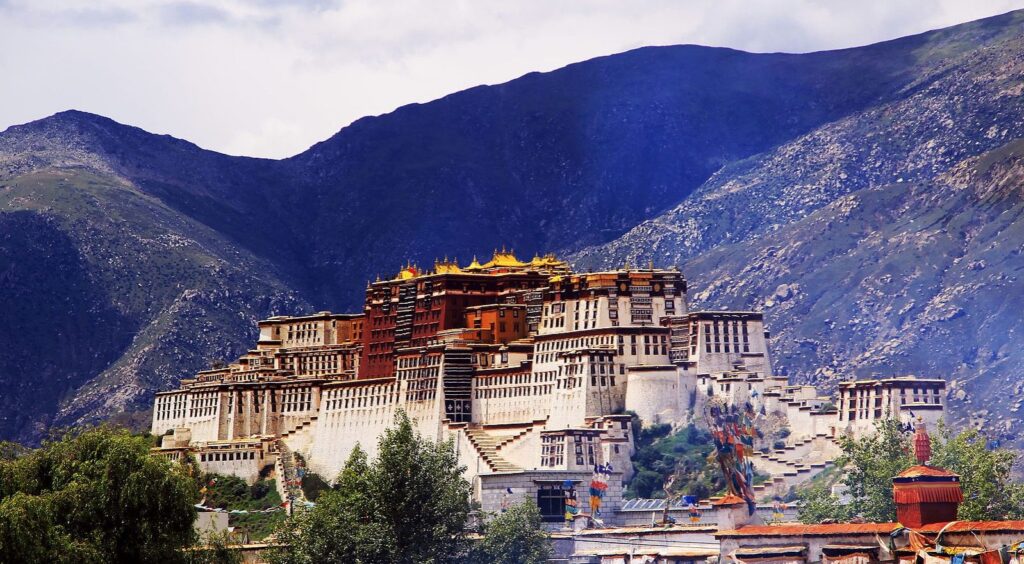
Before Jokhang Temple existed, Songtsen Gampo had already moved his capital from Tsetang in the Yarlung Valley to the north bank of the Lhasa River — fertile land, good climate, beautiful surroundings. He himself lived on the Red Hill. You have probably seen that hill already: it is the same hill where the Potala Palace stands today, though at that time there was no Potala — only a modest royal residence at the summit. The ordinary people lived in the area around where we are standing now. There was no Jokhang yet. There was nothing here but marshy ground.
Now: Songtsen Gampo had two queens. From Nepal he had married Princess Bhrikuti. From the Tang Dynasty he had brought Princess Wencheng. Both queens arrived carrying Buddha statues as gifts from their home kingdoms. Both statues needed a permanent home. So the king decided to build two temples.
But where?
Princess Wencheng applied her knowledge of Chinese geomancy and five-element divination to the landscape of Tibet, and made the following announcement:
The place where you are standing right now was, in the seventh century, a pond. A swamp. Songtsen Gampo assembled his people and they began filling it with earth — thousands of workers, carrying soil by day. But every morning they returned to find the pond exactly as it had been. The earth they had moved had vanished back into the water overnight.
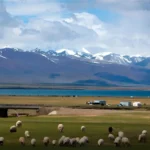
Princess Wencheng consulted her calculations again. The answer: only white goats carrying soil on their backs could fill this particular pond. And so it was arranged. Thousands of white goats were brought to Lhasa and set to work — load after load, day after day. And this time, it held.
The people of Lhasa, grateful to the white goats for making the city possible, named the place in their honor: Re-sa — White Goat Earth. The settlement that grew up around it took that name. Over the following centuries, Re-sa became Lha-sa .
That is the connection, William.
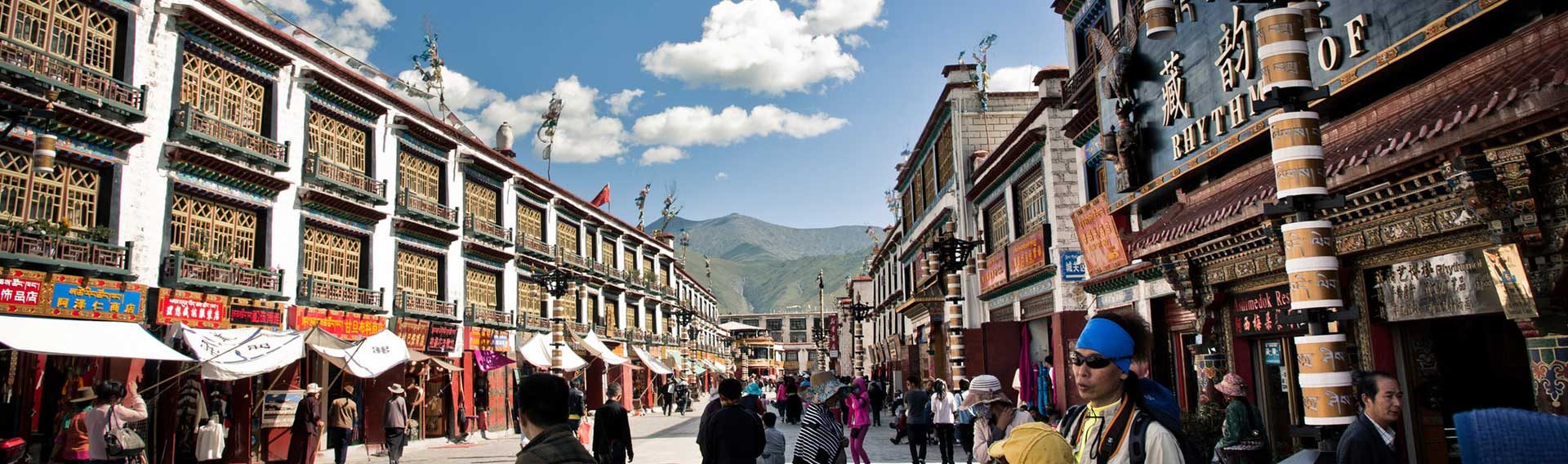
And that is also why, after this visit, we will walk Barkhor Street. Every building in Lhasa’s old city was constructed in a ring around Jokhang Temple — the spot the goats made possible. The street market surrounding us is not just a market. It is the city that grew from a filled pond.
Temple or monastery — before we go in
One last thing before we enter, and it is easy to keep straight in English. Jokhang is a temple , not a monastery . In Tibetan Buddhism, these are genuinely different institutions. A temple is where monks work — conducting rituals, receiving pilgrims, performing ceremonies. A monastery — like Sera or Drepung — is where monks study : years of scripture, philosophical debate, doctrinal examinations. Different purposes, different daily lives. Jokhang is a place of worship and ceremony. Keep that distinction and the rest of Tibet will make more sense.
Inside Jokhang — the main hall
The long hall in front of you, with rows of low cushioned seats, is where the monks chant morning and evening prayers. Ladies — please note that women may not sit on the raised central seating. This is the practice across Tibetan temples and monasteries.
We move clockwise — as all Tibetan religious circuits go, turning left from the entrance.
Stop here before we continue. I want to explain something you may have already noticed: there is paper money inside the side chapels. Notes and bills, left as offerings. And yet no one takes them. Or — almost no one. You may see someone reach into an offering box and remove some notes. This is not theft, and no one around you will react to it.
Here is what is happening: a worshipper wants to offer two yuan to this shrine, but has only a ten-yuan note. They place the ten in the box and take back eight as change. The offering stands — the temple receives what was intended. This is completely accepted practice, and it works at every economic level.
I have known pilgrims who had begged for ten yuan that day and placed eight of it in front of a statue. The wealthiest families in Lhasa do the same thing. This is the depth of the faith I am describing.
The slightly newer-looking statue in front of you — fresher in color than its neighbors — was donated by a wealthy Lhasa family. Their daughter fell seriously ill. The family came to Jokhang to pray for her. She recovered. In gratitude, they commissioned this statue and enshrined it here. This is how Jokhang has grown across thirteen centuries: prayer, recovery, gratitude, gift.
The Jowo Shakyamuni — the most sacred statue in Tibet
Move with me to this chapel — the one with the crowd pressing in from both sides. What is inside is the reason those pilgrims on the paving stones outside have walked here on their hands and knees from thousands of kilometers away.
This is the twelve-year Jowo Shakyamuni — a statue depicting the Buddha at the age of twelve, brought to Tibet by Princess Wencheng in the year 641 AD. But its history inside this building is more complicated than it first appears.
When Songtsen Gampo built the two temples, each queen made a request about direction. Princess Bhrikuti asked that her temple face west — toward Nepal, which lies to Tibet’s west. This became Jokhang. Her eight-year statue was enshrined here. Princess Wencheng asked that her temple face east — toward Chang’an and the Tang homeland. This became Ramoche Temple, a short walk north of where we stand. Her twelve-year Jowo was enshrined there.
So at the beginning: the Bhrikuti eight-year statue was in Jokhang. The Wencheng twelve-year Jowo was in Ramoche. Then came Lang Darma.
In the ninth century, a Tibetan king named Lang Darma came to power with fierce hostility toward Buddhism. Under his authority, a systematic persecution swept across Tibet: temples were closed and damaged, statues were destroyed, monks were killed or driven out. The two most sacred statues in Lhasa were in immediate danger.
The people guarding them made a decision: swap the statues and hide them inside the walls. The twelve-year Jowo from Ramoche was concealed behind the stonework of Jokhang. The eight-year Bhrikuti statue from Jokhang was hidden inside the walls of Ramoche. Both disappeared into the masonry.
When the persecution finally ended, the twelve-year Jowo was found and restored — to Jokhang, where it had been hidden. It has remained here ever since. The eight-year Bhrikuti statue, sealed inside the walls of Ramoche, was never successfully recovered. To this day, Ramoche Temple does not have it.
The statue looking down at you now is the one Princess Wencheng carried from Chang’an in 641 AD — nearly fourteen hundred years ago. That is what those people outside are prostrating themselves to reach.
The man who fetched her — Ludongzan and the nine-curving pearl
One more thing about Princess Wencheng before we move on. Songtsen Gampo did not go to the Tang court himself to ask for her hand. He sent his most trusted minister — a man of exceptional intelligence named Ludongzan. In Tibetan he is called Gar Tongzän.
The Tang Emperor set the same test for all the kingdoms competing for the princess. The task: thread a single silk thread through a pearl with nine internal curves — nine complete turnings inside the stone, no straight path from one end to the other. Every minister from every other kingdom tried and failed.
Ludongzan’s solution: he found a live ant, tied the silk thread gently around its waist, placed the ant at one opening of the pearl’s tunnel, and put a drop of honey at the other end. The ant walked through all nine curves on its own, following the scent of the honey, pulling the thread behind it. Ludongzan passed the test. He won Princess Wencheng for Tibet and escorted her on the journey that took four years to complete.
His full story — including what happened to him afterward — I will tell at the Potala Palace. For now, one more name worth holding from this same era: Yutuo Yundan Gongbu, the founder of Tibetan medicine. His story belongs to the Medicine King Hill, which we will see from there.
The hollow stone — the pond is still there
Before we go up to the roof — walk with me to this corner. The southeast corner of the main hall. Look at this stone, set high in the wall. There is a hollow in its center, a gap in the rock. They say that if you press your ear to it and listen carefully, you can still hear water — the underground marsh, the demon woman’s heart, the pond the white goats filled thirteen centuries ago.
Anybody want to try? Tell me if you can hear the water.
The right wall — the story painted
Before we head up — look at the wall to your right. This mural, running along the right side of the Main Hall just before the exit, depicts white goats moving in a line, their backs loaded with earth. This is the story I told you in Barkhor Square, before we entered. The demon woman’s heart. The pond that human hands could not fill. The goats that finally made it possible. The people who built this hall thirteen centuries ago thought that story was important enough to paint on the wall inside it. Now you have heard the explanation, and you can see what they remembered.
On the roof — prayer wheels and prayer flags
One more thing before Barkhor. As you travel through Tibet you will constantly see people holding small brass cylinders in their hands, spinning them as they walk — never stopping. These are prayer wheels. Written on a scroll of paper coiled inside each cylinder is a set of Buddhist sutras. Every complete turn of the wheel is equivalent, in religious terms, to having read those sutras aloud.
This practice was developed in the thirteenth and fourteenth centuries as a way of making religious participation accessible to people who could not read — which, for most of Tibetan history, was the majority of the population. The same logic applies to the prayer flags you will see strung across mountain passes: every time the wind moves them, it is reading the scripture printed on the cloth. The wind does the recitation. You do the hanging.
Follow me clockwise around the inner circuit of the main hall now — you can turn the large prayer wheels set into the outer walls as we walk. You do not need to read Tibetan. One turn is enough.
Out to Barkhor Street
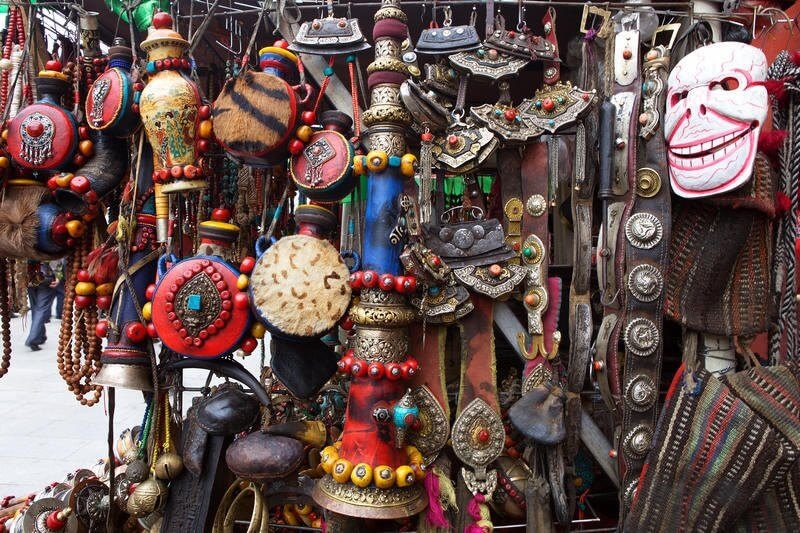
Follow me out through the main gate. You have 45 minutes of free time to walk the Barkhor circuit at your own pace. A practical note: bargaining is completely normal here — expected, even. Take your time.
And as you walk — look at the buildings around you. Every one of them is oriented inward around this temple. The whole of old Lhasa was built outward from the pond the goats filled. You are walking the reason it is called Lhasa.
About the storyteller
Mark
On the road since the winter of 2003 — and still guiding today. China’s retirement system says otherwise; Mark disagrees. He now works exclusively with clients who request him by name, and with TibetTravel.com’s most discerning travellers — never a common sightseeing group. He taught himself Tibetan mythology through ten volumes of fairy tales during his early years on the road, and has spent over two decades explaining these walls to astonished groups in a dozen languages.
Hear this story in person
We visit Jokhang on every Lhasa tour.
The stele, the willow, the demon woman, the Jowo, the mural, the hollow stone — and the story of Ludongzan continued at the Potala. All of it is part of every itinerary below.
Frequently asked questions
How did Lhasa get its name?
According to the legend told at the Jokhang, thousands of white goats filled a demon-haunted pond — and gave the city its name. The story is told on this page.
What is the Jowo Shakyamuni?
It is the sacred statue at the heart of the Jokhang Temple, and the story of how it came to be there — and was once hidden — is part of this page.
Where is the story told?
Mark tells it at the Jokhang, moving from the bus, to Barkhor Square in front of the main gate, past the incense burner and the pilgrims prostrating at the door.
We answer within 12 hours, Monday to Saturday.