
Stories from Tibet
The Hand on the Head — and the Rope
How Tibet’s living Buddhas are chosen, how one drove our tourist van, and how Mark became a Buddhist disciple with a Dharma name
Published 23 August 2026 · 20 min read
Three things most Tibet visitors never know
— Every monastery in Tibet has its own living Buddha. There are hundreds of them. The Dalai Lama and the Panchen Lama are only the most famous two.
— The difference between one kind of blessing and another is exactly three metres of rope.
— One of the living Buddhas I knew personally drove our tourist van every day, ate meat with the rest of us, and one morning simply did not come back.
Two hours on foot — time for sweet tea
We had been walking for two hours. Jokhang Temple, Barkhor Square, through the alleys, up to the roof. The kind of walking that fills the feet and empties the mind. I suggested a break.
Mark
Let’s find a local place and sit down. Sweet tea. Everyone comfortable?
We found a tea house — the kind that Lhasa residents use, not the kind built for tourists. Small tables, wooden chairs, thermos flasks kept hot on a low flame. The waitress brought bowls. We sat.
I drank one mouthful of tea. Before I could say anything else, one of the group members looked at me across the table.
Group member
Mr. Li, can I ask you a question?
Mark
Of course. Please.
Group member
Can you tell us why the living Buddha system exists? How does it actually work?
I put down my bowl. This is not a one-sentence answer. It is not even a five-sentence answer. I looked around the table.
Mark
The full explanation will take more than a quick break. Are you sure you want to hear it?
Group
Yes. Go on. We want to hear.
Why the system exists — the problem it was designed to solve
The living Buddha system — the system of reincarnated lamas — was not created for spiritual reasons alone. It was created to solve a political problem. A very human problem.
When a great monastery abbot dies, who comes next? In any ordinary organisation, the answer involves powerful people backing their preferred candidates, old loyalties, family connections, money, influence. The same political forces that determine who leads everything else. In Tibet, the monasteries were not just religious institutions. They were the centres of education, medicine, law, and authority. The succession of a great abbot was a moment of genuine danger — a moment when the peers and contemporaries of the old leader would compete openly or secretly for control.
The solution that emerged was elegant in its logic: the next leader cannot be chosen from among the contemporaries of the last one. The next leader must be the last leader — reborn. A child, found through a process that no adult faction can control. The succession passes not through human politics but through reincarnation.
That is the foundation of the entire system. Everything else — the search, the tests, the ceremonies — is built on that single idea.
How the search begins — the direction of the face
When a great lama enters parinirvana — when he dies — the monks who attend him observe something specific: the direction his face turns. If the body settles facing south, the search will begin in the south. If it faces east, the search goes east. This is the first indication.
But a direction is not a destination. The next step is to go to the sacred lake — Lhamoi Latso, the oracle lake in the mountains south of Lhasa. We spoke about this lake at Tashilhunpo. The surface of Lhamoi Latso is considered a mirror. Senior lamas make the journey there and sit in meditation beside the water, reading what appears in the reflection: images, shapes, letters, partial scenes. These visions are interpreted for further clues — a specific landscape, a distinctive building, the initial of a name. The direction is narrowed.
Then the search parties go out. They are looking for boys born at approximately the same time as the lama’s death — within the indicated region. Often there are several candidates. The real selection has not yet begun.
The object test — what a child reaches for
The candidates — sometimes two, sometimes four, sometimes more — are brought forward one by one. In front of each child, two sets of objects are placed on the floor.
The first set contains objects that belonged personally to the previous lama: his prayer beads, his ritual implements, items he used daily in his practice. These are old, plain, worn things. Not remarkable to look at.
The second set contains things designed to attract a young child: bright coloured toys, sweets, shiny objects. Things that any small child would naturally reach for first.
The test is simple. Which does the child reach for?
If the child ignores the toys and the sweets and picks up the old lama’s prayer beads — or his bowl, or his bell — that child is considered a strong candidate. The reasoning is direct: if this child truly carries the mind of the previous lama, some deep recognition will pull him toward objects that were part of that life, even if he cannot explain why.
Sometimes more than one child passes this test. They all reach for the correct objects. The search is not yet complete.
The Golden Urn — the final decision
When multiple children have each demonstrated recognition — when the object test alone cannot determine the answer — the Golden Urn ceremony is used.
The name of each remaining candidate is written on a slip of paper, which is then attached to a bamboo stick. All the sticks are placed inside a golden urn and shaken. They are shaken until one stick rises above the others and falls out. The name on that stick is the reincarnated lama.
We spoke about this system in more detail at Tashilhunpo — it was formalised by the Qianlong Emperor in 1793 as the Jinping Cheqian system, and a second golden urn was installed in the Potala Palace for Tibetan selections. The ceremony you see described in Qing dynasty records is the same ceremony still used today.
Look at the entire sequence together: the direction of the face, the oracle lake, the regional search, the object test, the golden urn. Each stage filters further. No single person controls the outcome at any stage. No family, no faction, no monastery elder can simply install their preferred candidate. The process itself is the safeguard — which is precisely why it was designed this way.
Group member
So how many living Buddhas are there in Tibet altogether?
Another group member
Two. You told us at Tashilhunpo — the Dalai Lama and the Panchen Lama. Right?
How many living Buddhas — the answer that surprises everyone
I smiled at this. It is the most common misunderstanding about Tibetan Buddhism among visitors, and it is completely understandable.
Mark
Partially right. But not complete. The Dalai Lama and the Panchen Lama are the two most famous — and the Karmapa, head of the Kagyu school, is the third most widely known. But in Tibet, every monastery has its own living Buddha. Every single one. There are hundreds of them. When we say “living Buddha” we are not describing a title held by two or three people. We are describing a system that runs through the entire fabric of Tibetan religious life.
The group was quiet for a moment.
Group member
So what does a living Buddha actually do every day? Do they just sit in the monastery and receive offerings?
Mark
That is a very good question. And I can answer it with a real story.
Karma the driver — the living Buddha who drove our tourist van
In the company where I worked before I started TibetTravel.com, there was a man named Karma. He worked as a driver. Every morning he got up, picked up the van, collected his group of tourists, and drove them around Lhasa. He ate the same meals as the rest of the staff. He ate meat. He complained about traffic. He was an ordinary colleague.
He was also a living Buddha.
He had told us, quite simply, that he was the recognised reincarnation of the previous abbot of a monastery in eastern Tibet — Kham. Every year, he would take leave from the company and return to that monastery for the annual blessing period. He would sit in the hall on the throne, and the local believers would come to receive his blessing, his hand on their heads. He would perform the ceremonies that were his by lineage and by recognition. Then he would travel back, put on ordinary clothes, and come back to work as a driver.
One year, he was driving and there was a serious accident — caused by the other driver. An elderly person was hurt. Karma handled everything properly and calmly. After the matter was fully resolved, he left the company. We never saw him again.
I have thought about him often. He lived in two completely different worlds simultaneously — the world of the monastery throne, where hundreds of believers knelt before him, and the world of the traffic lane, where he was just the man in the van. He held those two realities with complete naturalness. That, I think, is the thing about the living Buddha system that no textbook explains: it does not separate people from ordinary life. It moves through it.
‘Mr. Li — do you have a religion?’
We had been talking for a while. The sweet tea was still warm. One of the group members put her cup down and looked at me directly.
Group member
Mr. Li. Do you have a religion?
This is not a question guides are usually asked. I thought for a moment before answering.
Mark
Before 1997, no. I had no belief at all — nothing. After that year, I converted to Buddhism. I am a lay disciple now. But that is another story.
I moved to stand up. The tea house was comfortable. We had been sitting long enough.
Group member
No — please tell us. That is the story we most want to hear.
The Taiwan group — and the first visit to Tsurphu Monastery
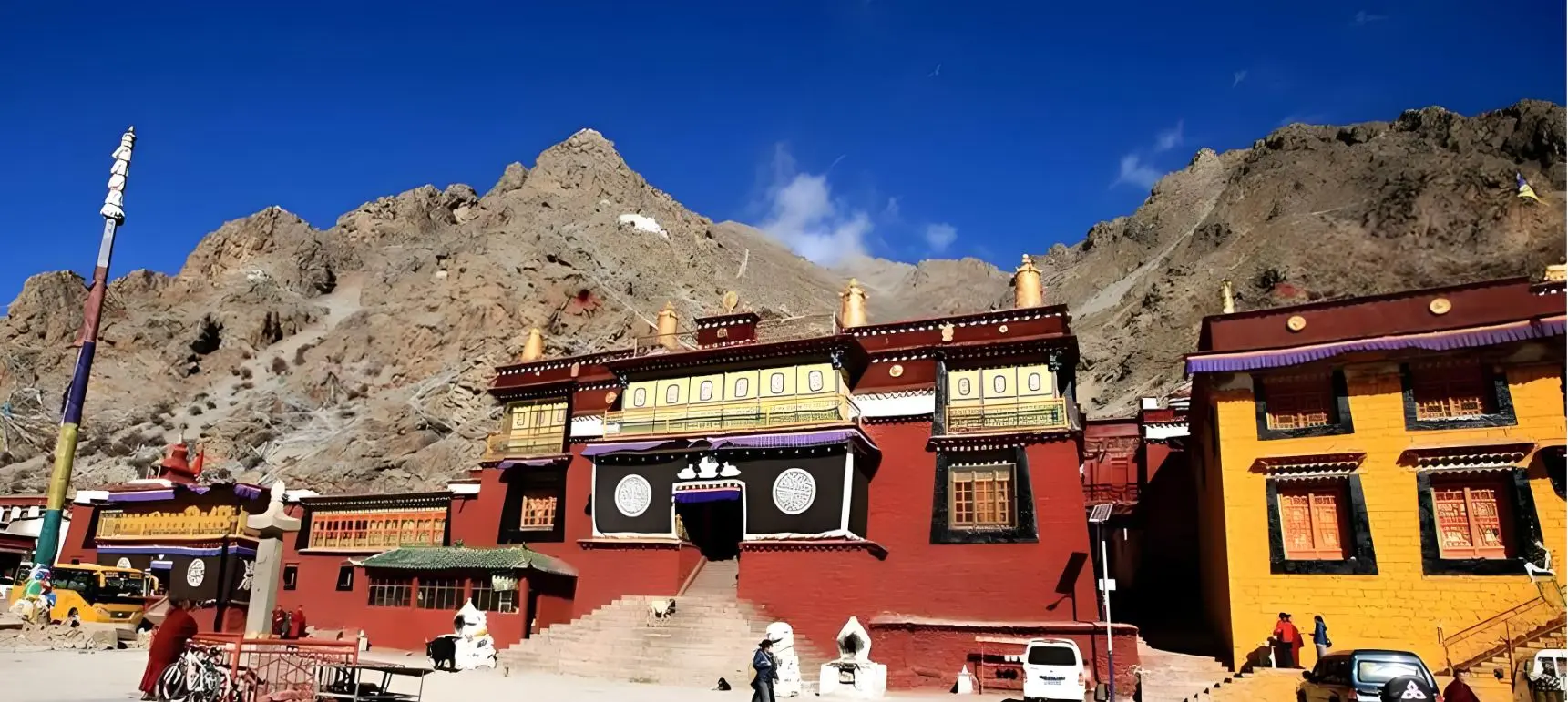
Several years before I started my own company, I was assigned a group from Taiwan. This was not an ordinary tourist group. They had come to Tibet under the name of the Taiwan Buddhist Association, accompanied by a female Buddhist nun who had organised the journey. There were more than ten people. Their purpose was not sightseeing. They had come specifically to Tsurphu Monastery — the seat of the Karmapa lineage, about seventy kilometres west of Lhasa — to worship and to make offerings.
The 17th Karmapa is the third-highest living Buddha in Tibetan Buddhism, after the Dalai Lama and the Panchen Lama. He resides at Tsurphu. The group had made this journey specifically to be in his presence.
On the first day, I watched the group members as they prostrated before the Karmapa. I watched their faces. The sincerity was complete — there was nothing performed or self-conscious about it. These were people who had travelled many thousands of kilometres for this moment. I had guided many groups. I had not seen devotion quite like this before.
That evening I spoke to the tour leader.
Mark
Tomorrow, when we come back — I want to convert. I want to take refuge in the Karmapa.
He looked at me for a long moment.
Tour leader
Good. We will all be your witnesses.
The next morning — and what no one expected
I arrived the next morning expecting to go through the conversion alone, with the group watching. What I found instead was this: every single member of the group had decided overnight that they also wanted to formally convert. All of them.
The Karmapa’s assistant monks conferred. The group had brought offerings and donations from Taiwan — items prepared specifically for this monastery. After a period of discussion, word came back: the Karmapa would receive all of us together. A ceremony would be held.
We were arranged in order. One by one, each person was called forward.
When my turn came, I walked to the front of the hall and knelt on the floor before the Karmapa’s throne. He leaned forward and placed his left hand on my head. He chanted — a passage of scripture, spoken quietly, just above me. Then he gave me my Dharma name.
After that, he reached for a thangka — a Buddhist painting on cloth. He dipped his left thumb into cinnabar ink and pressed it onto the surface of the painting, leaving a clear thumbprint. Then he handed it to me.
This was my thangka to keep. His thumbprint on it permanently.
Different names, different thangkas — one for each person
The ceremony was repeated for each group member in turn. But it was not identical for everyone. Each person received a different Dharma name. Each person received a different thangka — a different Buddha or Bodhisattva painted on each one.
Some received the Vajrasattva. Some received Manjushri, the Bodhisattva of wisdom. The thangka given to me was the Four-Armed Avalokitesvara — the Bodhisattva of Compassion, the patron deity of Tibet, whose human manifestation the Dalai Lama is considered to be. My Dharma name was Karma Lhunzhub Gyatso .
I stood to one side after my ceremony was complete, watching the others go forward. And it was while I was standing there, watching, that I saw something I had not noticed before.
The rope — what ordinary pilgrims received, three metres away
Between each individual conversion ceremony, while the next person was preparing to approach, the Karmapa picked up the end of a rope.
The rope was suspended between two wooden frames — stretched horizontally above the ground, with each end held up by a stand. The total length was about three metres. The Karmapa held one end. The other end hung in the air three metres away, at the far side of the room.
On the other side of that rope, at a distance, local Tibetan pilgrims were prostrated flat on the floor. Dozens of them, foreheads pressed to the ground, arms stretched forward. Ordinary believers who had come to Tsurphu for a blessing but were not part of our ceremony and would not approach the throne.
The Karmapa shook his end of the rope. The vibration travelled along it. At the far end, three metres away, the rope trembled and moved — and the tips of the prostrated pilgrims’ fingers, or the tops of their bowed heads, were touched by that movement.
That was their blessing. The Karmapa’s energy transmitted through three metres of rope, reaching them without his body approaching them.
I stood there with the Karmapa’s thumbprint on a thangka in my hands, his handprint still present on the top of my head, and I watched that rope move. The contrast was not something I had asked for or expected. But it was impossible to miss.
The meal, the square, and the 32 precepts
After the ceremony, the Karmapa invited the entire group to eat in the monastery. The meal was simple: potatoes, beef, rice. It was one of the best meals I have ever eaten. I cannot tell you exactly why. Perhaps it was the altitude, or the hunger, or the morning’s emotion. Whatever the reason, it was extraordinarily good.
After lunch, we were led out to the square in front of the main gate of Tsurphu. We sat in the open air, each person at a distance from the next. The Karmapa came out and took his seat on a high throne in the square. He chanted scripture over us for a period of time.
Then his assistant explained what had happened: through the ceremonies of the morning and the chanting of the afternoon, we had formally received the Bodhisattva precepts — thirty-two vows that govern the conduct of a lay Buddhist disciple. The core of these precepts is not killing. Not ordering killing. Not participating in killing. Not watching killing if it can be avoided.
Before the conversion, I could kill a chicken without a second thought. I could clean a fish without hesitation. These were ordinary daily tasks that required no consideration.
After the ceremony, I found I could not do either. This was not a decision I made. I did not choose to feel this way. I simply found, the next time the situation arose, that my hands would not do it. That I could not look at the scene. This is the thing about religious conversion that I could not have understood before experiencing it: it is not intellectual. It happens somewhere else.
The mosquito question — and what the nun said
I had hesitated before agreeing to convert, for a practical reason. I had turned it over in my mind the night before: if I accept the precept against killing, what do I do about mosquitoes? In Lhasa in summer, mosquitoes are not a minor inconvenience.
I put the question to the Taiwanese nun who accompanied the group.
Mark
If I take this vow — what do I do when a mosquito bites me?
She answered without hesitation.
The nun
You can brush it away. You cannot slap it.
The distinction is absolute and the boundary is clear. Drive it away from you. Do not end its life. This was the answer. It was enough.
The second visit — a second name
Several years later, the same Taiwanese group returned to Tsurphu Monastery. Same purpose: worship, offerings, donation. And again we were invited to sit in the square in front of the main gate for a blessing ceremony.
At the end of that ceremony, I received a new Dharma name.
My first name — given at the conversion — was Karma Lhunzhub Gyatso . My second name — given at this second visit — was Tashi Sherab Namgyal .
I carry both. And both, I was told, describe something the Karmapa saw.
Karma — belonging to the Karmapa tradition, placed within his lineage. Lhunzhub — virtues spontaneously and naturally fulfilled, without forcing. Gyatso — ocean: wisdom as vast and as deep as the sea. The same syllable appears in the Dalai Lama’s title — Dalai is the Mongolian translation of Gyatso . To be named with this syllable is to carry something of the ocean’s quality in your practice.
Tashi — auspicious, a good omen, a fortunate beginning. The same word that begins the Tibetan greeting Tashi Delek . Sherab — wisdom, the direct Tibetan equivalent of the Sanskrit prajna : not knowledge accumulated from books, but the clear seeing that cuts through confusion. Namgyal — victorious, triumphant, one who has overcome. Together: auspicious, endowed with true wisdom, victorious over all difficulties.
I have thought about why two names rather than one. My understanding is this: the first name describes the aspiration — what the practice is directed toward. The second name describes the result — what the practice, if followed, produces. They belong together.
Worth Knowing
This group was not an ordinary tour group. They came to Tibet under the name of the Taiwan Buddhist Association, accompanied by a senior nun, with specific religious purposes and formal offerings. Their relationship with Tsurphu Monastery was arranged through religious channels that are not available to standard tourist groups.
Because of this, our access was not ordinary access. The secret tantric meditation room of the Dalai Lama — a room that is inaccessible to virtually every visitor to Tibet, regardless of budget or connection — we entered. This was not something that money could buy or that any travel company could arrange through ordinary means. It was extended to us because of who the group was and what their purpose was.
I mention this not to boast about access, but because it illustrates something real about Tibet that most visitors do not encounter: there is the Tibet that is available to tourists, and there is a different Tibet that opens only through genuine religious relationship. The distance between the two is not measured in money. It is measured in sincerity.
More stories from the same journey
The Two Great Lineages
Tashilhunpo Monastery · Shigatse — the Dalai Lama, Panchen Lama, and the Golden Urn
The White Goats That Named a City
Jokhang Temple · Lhasa
Neither the Buddha Nor You
Potala Palace · Lhasa
The Murals on the Wall
Norbulingka · New Palace · Lhasa
Frequently asked questions
How are living Buddhas, or reincarnations, found?
The story explains the full process — from the direction a dying lama faces, to the object test that identifies the child, to the Golden Urn.
What is the Golden Urn?
It is the ceremony used to confirm the choice of a reincarnation in some cases, explained in the story told on this page.
What do most visitors never know about this?
There are three things most visitors never learn about how reincarnation is determined — all explained here, with time for sweet tea on the two-hour walk.
Before you send your inquiry
- No deposit — ever. Your dates are held with a free inquiry, and nothing is due until we confirm. On fixed group departures, book early to secure your seats.
- Cancel free before your Tibet Travel Permit is issued — full refund, every dollar.
- After the permit is issued: the USD $100 permit fee is non-refundable, everything else is refunded. Refunds within 7 business days.
- Bring a group of 7 and your spot is free (7+1).
- Single room supplement — free of charge for any group booking 5 rooms or travelling with 10 or more.
- Tell us your dates and route on the form below — you will have a written itinerary and an item-by-item quote within 12 hours, with no obligation to book.
- Prices depend on group size, hotel standard, season and how you travel into Tibet, so we quote each trip individually rather than from a price list.
- Hotel details — the exact hotels we use — come with your quote. Ask below for the standard you would like and we will match it.
- A Lhasa-based Tibet tour operator since 1999 — our own guides, vehicles and office in Lhasa, 7,200+ travellers from 40+ countries, 4.9★ on TripAdvisor.
We answer within 12 hours, Monday to Saturday.