
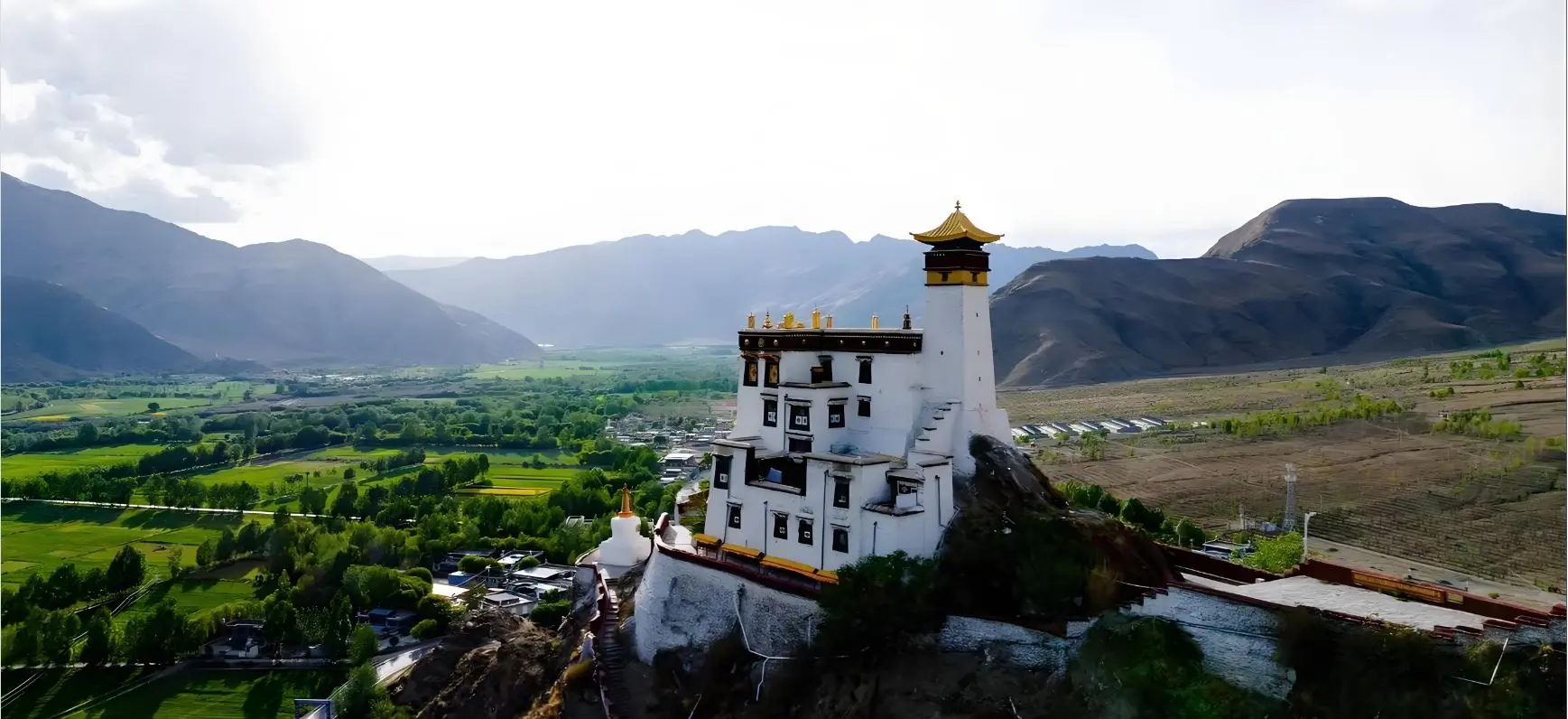
Stories from Tibet
The Doe’s Hind Leg Palace
Tibet’s oldest palace, its first king, its first farmland — and the two prayer wheel rules that Tibetan locals have never once explained to a tourist
Published 27 August 2026 · 18 min read
Three things most Tibet visitors never learn
— A man pointed upward to say “I came from over that mountain.” The people watching him thought he meant he fell from the sky. That misunderstanding made him Tibet’s first king.
— The correct way to spin a prayer wheel involves watching the person behind you. And you must never, under any circumstances, touch the bronze.
— This palace was built because a tent at the top of a hill would simply blow away in the wind. Practicality, not ambition, created Tibet’s oldest royal building.
The cradle — why everything in Tibet starts here
We are now in Shannan Prefecture — the region Tibetans call the birthplace of their civilisation. This is not a marketing phrase. There is specific evidence for it in almost every direction you look from this valley. Over the next two days we will visit the sites that justify the claim one by one.
Tsetang, the main city of Shannan, takes its name directly from the monkey origin story I told you at Norbulingka — tse means monkey, tang means playground. The monkey’s cave on Gongboiri Mountain is nearby. Tibet’s first barley field is here. The first palace is here. The first king is from here. The first monastery with all three jewels of Buddhism — Buddha, Dharma, and Sangha — is here. The Tibetan script was created in this era. The capital, before it moved to Lhasa, was here.
Shannan is not one story. It is the opening chapter of everything. Today we start at Yumbulakhang.
What ‘Yumbulakhang’ means — a doe, a mountain, and a hind leg
Before we go inside, look at the mountain this palace stands on. The mountain is called Trashi Tseri. Look at its shape from the side — the ridge, the slope, the way it extends outward at one end. To the people who named it, this mountain looked like a resting female deer, a doe, with one hind leg stretched out.
In Tibetan: yum means a female deer or doe. bu relates to the hind leg. la is a connective particle. khang means a building, a house, a palace. Put them together and Yumbulakhang means exactly this: the palace on the doe’s hind leg. The building is not at the very top of the mountain — it sits on the section that resembles the leg, extending outward from the body of the ridge.
Many visitors say it reminds them of a miniature Potala Palace. They are not wrong to notice the resemblance — a white building on a hilltop, a tower rising from it, commanding everything below. But this palace predates the Potala by almost two thousand years. The Potala came later. It is the Potala that follows this tradition, not the other way around. The instinct to build a palace high on a hill, visible from the valley floor — that instinct was born here.
The man who came from the sky — Tibet’s first king
The construction of Yumbulakhang is tied to a story. A very specific story about a very specific stranger.
Long ago — tradition places this in the 2nd century BC — an unusual man appeared in the Yarlung valley. He was unlike anyone the local people had seen. Several things about him were immediately strange. His eyelids closed upward rather than downward — the opposite of how normal eyes close. His eyelashes were green. His teeth were large and very white. And between his fingers there was a membrane — a thin webbing of skin connecting them, the way a waterfowl’s feet are joined.
The valley people gathered around him. They asked where he had come from. The problem was language: his dialect and theirs did not match. He could not make himself understood in words. So instead he did what a person does when words fail — he pointed. He pointed upward, over his shoulder, toward the high mountains behind him. What he meant was: I came from over there, from beyond that ridge.
But the people watching him did not look at the mountains. They looked at his finger, pointing skyward, and they drew the most natural conclusion available to them: he had come from above. From heaven.
A man from heaven, standing among them. They did what the moment seemed to require — they lifted him onto their shoulders and carried him, as a mark of the highest reverence. And from that gesture came his name: Nyatri Tsenpo — “the king whose throne is the neck and shoulders of his people.” He became the first Tsenpo, the first ruler of Tibet, the first in the royal lineage that would eventually produce Songtsen Gampo thirty-two generations later.
A king needs a residence. A tent at the top of a hill in this wind was not a serious option — the wind at this altitude would have sent it into the valley before nightfall. Stone and mud, fitted to the ridge: that was the solution. The first stone building in Tibetan history was built not out of grandeur, but out of simple practical necessity. And because a man from heaven cannot live at the same level as ordinary people, it had to be high.
From tents to houses — one palace changes how people live
The palace created something it did not intend to create: a model.
Before Nyatri Tsenpo and his stone building, the people of the Yarlung valley lived as nomads — following their yaks through the seasons, living in tents that could be moved. The tent was both home and vehicle. Permanent structures simply did not exist.
When the people saw that a building could be made from stone and mud and stay standing — that it did not blow away, that it could shelter a person through the winter — they drew an obvious conclusion. If a building like that could be built for a king, it could be built for anyone. And so, one by one, people began building their own stone houses in the valley. The first settlement grew around the hill.
The change this produced was permanent. A nomad follows the land. A person with a house is followed by the land — the land becomes fixed, known, yours. Settlement made ownership possible. Ownership made agriculture possible. And agriculture changed everything.
Tibet’s first farmland — visible from where you are standing
Look to the right of the palace as you face it. The terraced fields spreading out across the valley floor below — those fields are not ordinary farmland. They are the continuation of what was, according to Tibetan tradition, the first land ever cultivated in Tibet.
The story connects to the monkey origin legend. When the descendants of the sacred monkey had multiplied and the wild fruit of the mountain was no longer enough to feed them, heaven sent down the five sacred grains — barley, wheat, rice, buckwheat, and beans. The grain landed here, in this valley, on this soil. The earliest attempt to plant and harvest rather than gather began here.
From the palace above, the Tsenpo could look down on the people working the fields. The view from this hilltop was not just defensive — it was administrative. A ruler who could see his people, and be seen by them, had authority that no nomadic chief could claim.
Yumbulakhang was built as a fortress. It became a palace. Then it became a watchtower over the first farmland in Tibet. Its purposes accumulated the way civilisations accumulate their purposes — one layer at a time, never quite leaving the previous one behind.
Four treasures that nobody could read — how the palace became holy
The palace’s evolution did not stop at military and administrative uses. A turning point came during the reign of the 28th king — around the 5th century AD — when a group of Indian monks passed through the Yarlung valley on their travels.
They left four objects behind. These four objects would later be considered heaven-sent treasures: a text of the six-syllable mantra — Om Mani Padme Hum ; a small reliquary stupa containing sacred remains; a palm-leaf scripture with Sanskrit text — what is called a pothi , or palm-leaf manuscript; and a text of Buddhist rules and precepts.
The problem was that nobody in Tibet could read Sanskrit. These objects were clearly important — their material, their weight, the careful way the monks had carried them all suggested significance. But their meaning was inaccessible. So the king did the only reasonable thing: he placed them in the palace as sacred objects, to be preserved and venerated until someone, eventually, could explain what they said.
Those four objects became the foundation of Buddhism’s entry into Tibet. The Dharma — the teaching — had arrived in physical form, even if it could not yet be read. The palace now held something beyond political or military value. It had become a repository of the sacred.
Look at the pillar standing in front of the entrance as you approach. One single pillar. That pillar represents the Dharma — the second of the Three Jewels of Buddhism. It was placed there to mark what this building now contained.
When Songtsen Gampo came — the 33rd king, in the 7th century — his Nepali wife Princess Bhrikuti and his Tang dynasty wife Princess Wencheng each brought a sacred Buddha image with them into Tibet. Those images were the Buddha — the first of the Three Jewels. The palace now carried both Buddha and Dharma. You will notice, in front of the building today, two pillars rather than one. The second was added when the Buddha images arrived. One pillar for Dharma. A second for Buddha.
The third jewel — the Sangha, the community of ordained monks — came later. That story belongs to Samye Monastery, which we will visit tomorrow.
The prayer wheel — two things that Tibetan locals never explain
You have seen prayer wheels at every monastery on this tour. You have probably spun a few. Most visitors spin them the way they seem most natural: grab the bronze cylinder and give it a turn. I want to tell you two things about prayer wheels that Tibetan locals know and have never once thought to explain to anyone.
What Locals Know
The first secret: how to spin when someone is behind you.
Inside every prayer wheel is a tightly wound scroll containing the six-syllable mantra — Om Mani Padme Hum — written thousands of times. Each full rotation of the wheel is considered equivalent to reciting the mantra once. The more rotations, the more merit accumulated.
Most tourists spin the wheel as fast as possible, for as many rotations as they can manage before moving on. But watch what a local Tibetan does before spinning. They glance behind them. If someone is waiting, they spin the wheel gently — a slow, deliberate rotation rather than a fast one. If no one is behind them, they spin more freely.
The reason: a fast spin leaves the wheel still moving when you step away. The person behind you receives the continuing rotation as a gift — merit they did not earn but receive freely from your generosity. To consciously give merit to someone behind you is considered more virtuous than keeping all of it for yourself. In Buddhist logic: the more you give away, the more completely yours it becomes.
The second secret: never touch the bronze.
Look at how a local Tibetan actually makes contact with the prayer wheel. They are not touching the bronze cylinder at all. Their fingers rest on the wooden axle at the bottom — the central rod around which the cylinder rotates. The bronze is left untouched.
The reason is this: the bronze surface of a prayer wheel is the body of the Bodhisattva. To place your hand on it is to touch the face of a Bodhisattva — a gesture so presumptuous it cannot be undone. The wooden axle is neutral. Touch the axle, not the bronze. Turn the wood, not the gold.
Now you know. And now, when you watch other tourists grabbing the bronze and spinning hard, you will understand what the Tibetan believers standing quietly beside them are thinking.
Tibetan script — why it was invented, and who wrote it
We spoke a moment ago about the four Sanskrit objects left by the Indian monks — objects that sat in Yumbulakhang for two centuries because nobody could read them. This is the background to one of Songtsen Gampo’s most consequential decisions.
He sent a minister named Thönmi Sambhota to India. The mission was specific: go to India, study Sanskrit, come back, and create a writing system for the Tibetan language. Not translate Sanskrit into Tibetan — a writing system did not yet exist for Tibetan to be translated into. Create the script itself.
Thönmi Sambhota studied in India and returned. Sanskrit has fifty syllabic characters. Working from this foundation, he designed thirty consonants and four vowel markers that fit the sounds of spoken Tibetan. The Tibetan script was not copied from Sanskrit — it was built using Sanskrit as its model, reshaped to serve a completely different spoken language.
The reasons Songtsen Gampo wanted this were practical and political. Wencheng and Bhrikuti had brought Buddhist scriptures into Tibet. Those scriptures were in Sanskrit and Chinese — languages Tibet could not yet read. A unified, written Tibetan language would make translation possible. It would also make record-keeping possible, correspondence possible, legal codes possible. A kingdom without writing is limited in what it can govern and remember. A kingdom with writing can build institutions that outlast any individual king.
The Tibetan script created by Thönmi Sambhota is still in use today, unchanged in its essential form. Every prayer wheel you have spun on this tour contains the mantra written in those same thirty consonants and four vowels. A script invented in the 7th century to translate Buddhist scripture is now carried inside every golden cylinder in every monastery in Tibet.
Inside the palace — two floors, two purposes
When we go inside, the layout is simple and clear. The ground floor is the Dharma King Hall — Chögyel Lhakhang . This is where the statues of the early Tibetan kings are kept, the figures who built the civilisation we have been talking about all morning. The walls record the lineage from Nyatri Tsenpo onward.
The upper floor holds the Buddhist scripture hall — the room where the sacred texts are kept and where monks perform their daily recitations. The division between the two floors reflects the dual nature of this building across its entire history: it began as a seat of royal authority and became, over centuries, a place of religious practice. Both are still present, one above the other, exactly as the history unfolded.
What you see now is not the 2nd-century original. The building has been restored and rebuilt many times across twenty-two centuries. But the location is unchanged. The hill is the same hill. The view over the Yarlung valley is the same view that Nyatri Tsenpo had — the valley floor spreading out below, the fields that became Tibet’s first farmland, the mountains enclosing everything on three sides.
Day 2 in Shannan — continue reading
The Tibetan Kings Tombs — where sky burial is not the whole story — and Samye Monastery, Tibet’s first complete monastery, built as a three-dimensional model of the Buddhist universe.
More stories from the same journey
The White Goats That Named a City
Jokhang Temple · Lhasa
The Murals on the Wall
Norbulingka · New Palace · Lhasa — includes the monkey origin story and Tibet’s first farmland
The Two Great Lineages
Tashilhunpo Monastery · Shigatse
The Hand on the Head — and the Rope
How living Buddhas are chosen · Mark’s Buddhist conversion
Frequently asked questions
What is Yumbulakhang?
It is Tibet’s oldest palace and, in the stories told here, the cradle of almost everything Tibetan — the first king, the first farmland, and the beginnings of Tibetan script.
Who was Tibet's first king?
Nyatri Tsenpo — the man said to have come from the sky, the first king in the legend that begins at Yumbulakhang.
What do most visitors never learn here?
The stories cover why everything in Tibet starts in this valley, how one palace changed how people lived, and how Tibetan script came to be invented.
Before you send your inquiry
- No deposit — ever. Your dates are held with a free inquiry, and nothing is due until we confirm. On fixed group departures, book early to secure your seats.
- Cancel free before your Tibet Travel Permit is issued — full refund, every dollar.
- After the permit is issued: the USD $100 permit fee is non-refundable, everything else is refunded. Refunds within 7 business days.
- Bring a group of 7 and your spot is free (7+1).
- Single room supplement — free of charge for any group booking 5 rooms or travelling with 10 or more.
- Tell us your dates and route on the form below — you will have a written itinerary and an item-by-item quote within 12 hours, with no obligation to book.
- Prices depend on group size, hotel standard, season and how you travel into Tibet, so we quote each trip individually rather than from a price list.
- Hotel details — the exact hotels we use — come with your quote. Ask below for the standard you would like and we will match it.
- A Lhasa-based Tibet tour operator since 1999 — our own guides, vehicles and office in Lhasa, 7,200+ travellers from 40+ countries, 4.9★ on TripAdvisor.
We answer within 12 hours, Monday to Saturday.