
Stories from Tibet
The Yogurt Festival
What “Shoton” actually means, why monks’ summer confinement became Lhasa’s biggest party, and what the thangka at dawn looks like
Published 23 August 2026 · 15 min read
What we just saw at Norbulingka — and what happens here every August
We have just walked through the New Palace. You have seen the Four Harmonious Brothers, the Wheel of Life, and the 301 murals that record the full sweep of Tibetan history. What I want to tell you now is that this park — Norbulingka, which we have been walking through — becomes a completely different place once a year.
This year, it happened between August 12 and 18. If you had come then, the entire garden would have been covered in coloured tents. Every family in Lhasa packs food, blankets, and relatives, comes to this park, and stays for days. There is singing. There is Tibetan opera performed on open stages. There are bowls of yogurt everywhere.
This is the Shoton Festival — Tibet’s second greatest celebration, after the Tibetan Lunar New Year. It has been going on for centuries. And almost everything that visitors are told about it misses what makes it genuinely interesting.
What ‘Shoton’ means — starting with the word itself
In Tibetan, shö (雪) means yogurt — specifically the thick, sour fermented milk of the dri, the female yak. Tön (顿) means a feast, a banquet, the act of eating together. Put them side by side and Shoton means exactly what it sounds like: the Yogurt Feast. The Yogurt Festival.
It goes by other names too. In Chinese it is sometimes called 晒佛节 — the Thangka Display Festival — because of the giant sacred painting that is unrolled at sunrise on the first morning. And it is also called the Tibetan Opera Festival, 藏戏节 , because of the days of opera performances that follow. All three names are correct. They describe three different parts of the same celebration.
In 2006 the Shoton Festival was added to China’s national list of intangible cultural heritage. It is one of the few living festivals in Tibet that has maintained every layer of its original form: the religious ceremony, the performing arts, and the communal feast, all happening in the same place in the same week.
How it began — two months of closed monastery gates
The Shoton Festival was not always a public celebration. In its earliest form it had nothing to do with opera, tents, yogurt stalls, or crowds. It was a quiet religious custom observed inside monastery walls.
Gelug school monasticism follows a rule called the Summer Retreat — in Tibetan, yarne . During the Tibetan lunar fourth, fifth, and sixth months — roughly May through July — the mountain paths are alive with insects. Grass grows fast. The ground is full of small creatures that cannot be seen: ants, worms, larvae, beetles. A monk walking carelessly in this season would almost certainly step on living things and cause their deaths. To do so is to commit the act of killing — one of the gravest violations of Buddhist monastic vows.
To prevent this, the entire community of monks was confined to the monastery for the full duration of the retreat. No one left through the gates. No one walked the mountain paths. Monks stayed inside, meditated, chanted, studied, and kept their vows intact. For more than two months, the monastery lived in a kind of voluntary enclosure.
On the thirtieth day of the Tibetan lunar sixth month, the retreat ended. The monks were released. They could walk down the mountain again.
The people of Lhasa had been watching the monastery calendar. They knew the date. And because yaks produce their richest milk in summer — the same summer the monks had been confined — ordinary families had spent weeks making yogurt: thick, fermented, dense yak-milk yogurt that had been sitting in clay pots and wooden buckets all through the warm months. When the monks came down, the people of Lhasa brought their best yogurt to the monastery gates and offered it to the monks who had just emerged. A gift of food after a long discipline. A simple human gesture of respect.
That offering was the Shoton Festival. That was everything it was, in the beginning: monks came out, people brought yogurt. Nothing more.
How a religious custom became Lhasa’s biggest party
The transformation happened in layers, over centuries.
In the seventeenth century, when the Gelug school consolidated its authority over Tibet under the Fifth Dalai Lama, the festival gained its second element: Tibetan opera. Troupes were invited to perform at the monasteries as part of the celebration. The yogurt offering and the opera performance became linked. The festival grew.
Then Norbulingka was built — the Summer Palace that you have just walked through. As the Dalai Lama’s garden became the centre of Lhasa’s summer life, the focus of Shoton shifted with it. The main festivities moved from Drepung Monastery down into Norbulingka’s grounds. And when the gates of Norbulingka opened to the public during the festival, everything changed.
Ordinary families could now come inside — into the Dalai Lama’s own garden — and spend the festival days there. They brought tents. They brought food. They brought their grandparents and their children. They spread out under the willow trees of Norbulingka, set up camp, and stayed for days. This practice of camping and picnicking in the garden is called guo linka — “spending time in the park.” It is still the heart of Shoton for most Lhasa families today.
What began as a monk coming through a gate accepting a bowl of yogurt had become, across three or four centuries, one of the largest communal gatherings in Tibet. The religious ceremony, the opera, the feast, and the camping all layered on top of each other — and stayed.
Day one: dawn at Drepung — the thangka that covers a hillside
The festival opens before sunrise. Not at a reasonable hour. At three or four in the morning, tens of thousands of pilgrims and visitors start climbing the hill to Drepung Monastery — the largest monastery in Lhasa, and the one where the Shoton thangka display is held at the greatest scale.
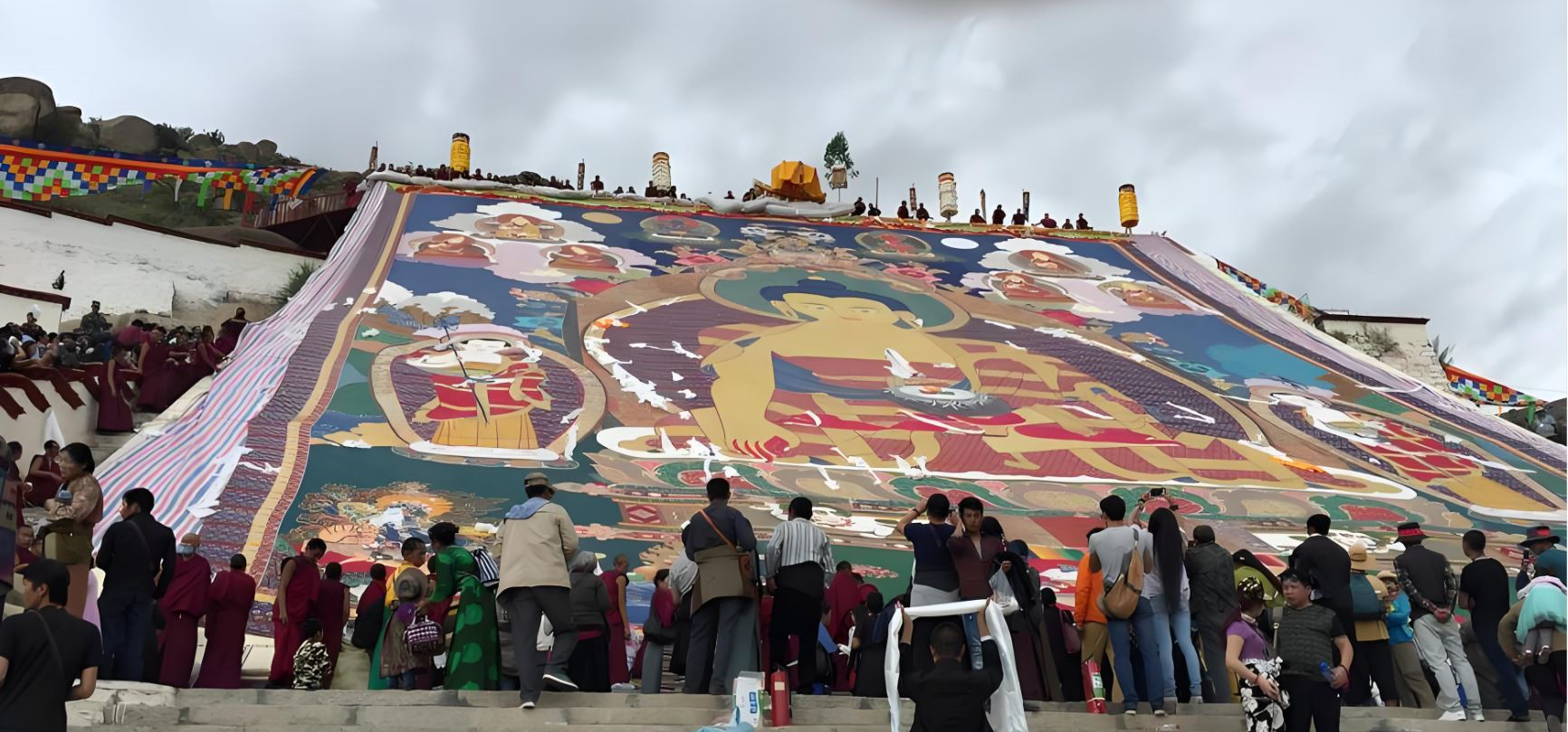
Inside the monastery, monks have spent hours preparing. A sacred thangka — a Buddhist painting on cloth — of enormous size has been carefully rolled and carried up to the hillside above the monastery. This is not a small painting. This is a thangka that covers the entire face of the hill: dozens of metres across, a Buddha image large enough to be seen from far below.
As first light touches the mountain, the monks begin to unroll it. Slowly, across the pale rock of the hillside, the image opens. The Maitreya — the Future Buddha, the one who is yet to come — appears in full colour as the sun rises. Gold robes. A face of immense calm. The crowd below is silent while it opens.
Then pilgrims move forward. They prostrate in front of it. They throw white khatags — silk scarves — upward toward the image. They circle it, murmuring prayers. To see this thangka is considered enormously auspicious. Many people have come from days away to be here for this single morning.
It does not stay up. Once the sun has climbed higher — once the display hour is complete — the monks roll the thangka back up carefully and carry it back inside. The painting is stored for another year. The hillside is empty again by mid-morning. The whole thing lasts perhaps three hours. Those three hours are the reason people arrive at four in the morning.
The Drepung thangka is the largest and most famous display. But on the same festival afternoon, as the sun shifts, Sera Monastery — on the other side of Lhasa — holds its own thangka display. Two monasteries, one day, both worth attending if you have the energy.
The opera, the tents, and the yogurt — Norbulingka
After the thangka display, the festival moves to Norbulingka. And this is where it stays for the rest of the week.
The opera troupes come from all over Tibet. Different groups perform on different days — sometimes several troupes in a single afternoon, on different stages across the park. Tibetan opera — lhamo — is nothing like Western opera. The performers wear large, vivid masks: each colour carries a meaning. White masks represent good and righteous characters; red and black masks represent powerful or fearsome ones. The singing style is high-pitched and sustained, unlike anything else in Asian performing traditions. The stories come from ancient Buddhist texts and Tibetan folk legends — Nangsa Wöbum , Drowa Sangmo , stories that have been performed without interruption for four hundred years.
You do not need to understand the Tibetan language to be held by it. The costumes, the masks, the percussion, and the sheer physical energy of the performance carry even those who cannot follow a single word.
Around the performance stages, the rest of Norbulingka is a city of tents. Lhasa families arrive with everything: rugs spread on the grass, thermoses of butter tea, bottles of barley wine, trays of food, and the bowl of yogurt that gives the festival its name. Grandparents sit in folding chairs. Children run between the tents. The sound of song — not opera, just ordinary Tibetan singing — comes from every direction. Some families sleep here for two or three nights rather than going home.
This is guo linka — spending time in the park. It is impossible to fully understand Lhasa culture without understanding this: that for Tibetan people, the best thing a good season can offer is a garden, company, food, and time. Not speed, not efficiency, not productivity. Time. The Shoton Festival is the official permission — sanctioned by a thousand years of tradition — to stop and simply be.
The yogurt — what to order and how to eat it
The yogurt served during Shoton is not what you buy in a supermarket. There is no sugar in it. There are no thickeners, no additives, no flavouring. It is pure yak-milk yogurt — white, dense, heavily soured by natural fermentation, with a surface that holds the weight of a spoon without breaking.
The correct way to eat it is simple: the vendor places a spoon of white sugar on top. You stir it through slowly, then eat it in the same sitting. The combination of the sharp sourness and the clean sweetness of the sugar is unlike any dairy product you have tasted elsewhere. Rich, thick, alive with fermentation. The yak produces its best milk in summer, and summer is exactly when this yogurt is made.
If you come to Lhasa during the Shoton Festival, eating a bowl of yogurt this way — from a street stall, with a wooden spoon, with a spoonful of white sugar dissolving into the surface — is not optional. It is the point of the entire festival. It is the thing the festival is named after.
When does Shoton happen — and why the date moves every year
The Shoton Festival does not fall on a fixed date in the international calendar. It follows the Tibetan lunar calendar: the thangka display at Drepung takes place on the thirtieth day of the sixth Tibetan lunar month, and the festival runs for approximately six days afterward.
In the international calendar this translates to mid-to-late August — but the exact dates shift by several days from year to year, because the Tibetan lunar calendar and the solar calendar do not align evenly. In 2026 the festival ran from August 12 to 18. In another year it might fall a week later.
If you are planning a trip around Shoton, the best approach is to look up the Tibetan lunar calendar for the specific year you are travelling, or ask your guide to confirm. The core sequence — thangka at dawn, opera in Norbulingka, families camping in the park — does not change from year to year. Only the dates do.
Worth Knowing
Shoton is a Lhasa festival. This matters, and most online sources do not say it clearly. The Shoton Festival — the thangka display at Drepung, the opera performances, the guo linka camping at Norbulingka — happens in Lhasa. It does not happen across all of Tibet.
Shigatse, for example, has its own major festival — held in the first week of June in the solar calendar, and on a scale as significant to Shigatse as Shoton is to Lhasa. A different city, a different month, a different celebration. The two are not the same event in different places. They are two entirely separate traditions.
The same applies to the Tibetan Lunar New Year. Most people outside Tibet assume it is celebrated on the same day across the entire plateau. Historically, it was not. Different regions celebrated it at different times. The western areas of Tibet — closer to what is now Nepal — celebrated earliest. Lhasa celebrated in the middle. The eastern areas, Kham and Amdo, celebrated later. The reason for the staggered timing reaches back to the early twentieth century, when men from the Shigatse area — Gyantse — were called to fight in the resistance against the British expedition of 1904. Soldiers from Shigatse celebrated the New Year and then marched to battle. Lhasa celebrated afterward. The eastern regions followed. A military mobilisation, a century ago, is still visible in the calendar today.
More stories from the same journey
The White Goats That Named a City
Jokhang Temple · Lhasa
Neither the Buddha Nor You
Potala Palace · Lhasa
The Two Great Lineages
Tashilhunpo Monastery · Shigatse
The Murals on the Wall
Norbulingka · New Palace · Lhasa
Frequently asked questions
What does 'Shoton' mean?
The story begins with the word itself — ‘Shoton’ is the Tibetan name behind what is often called the Yogurt Festival, and the meaning of the word explains the whole celebration.
How did the Shoton Festival begin?
It grew out of the monks’ two-month summer retreat behind closed monastery gates, when lay people brought them yogurt — and it became Lhasa’s biggest annual party.
What happens at the festival today?
There is the dawn unfurling of the giant thangka, and the days that follow are given over to celebration and, of course, yogurt.
Before you send your inquiry
- No deposit — ever. Your dates are held with a free inquiry, and nothing is due until we confirm. On fixed group departures, book early to secure your seats.
- Cancel free before your Tibet Travel Permit is issued — full refund, every dollar.
- After the permit is issued: the USD $100 permit fee is non-refundable, everything else is refunded. Refunds within 7 business days.
- Bring a group of 7 and your spot is free (7+1).
- Single room supplement — free of charge for any group booking 5 rooms or travelling with 10 or more.
- Tell us your dates and route on the form below — you will have a written itinerary and an item-by-item quote within 12 hours, with no obligation to book.
- Prices depend on group size, hotel standard, season and how you travel into Tibet, so we quote each trip individually rather than from a price list.
- Hotel details — the exact hotels we use — come with your quote. Ask below for the standard you would like and we will match it.
- A Lhasa-based Tibet tour operator since 1999 — our own guides, vehicles and office in Lhasa, 7,200+ travellers from 40+ countries, 4.9★ on TripAdvisor.
We answer within 12 hours, Monday to Saturday.