
Stories from Tibet
The Murals on the Wall
The Four Harmonious Brothers, the Wheel of Life, and 301 murals of Tibetan history — what Mark explains before tourists even reach the stairs
Published 23 August 2026 · 18 min read
The Summer Palace — what Norbulingka is
You have already seen the Potala Palace. That is the Winter Palace — the formal seat of the Dalai Lama’s government, the place of ceremony and state. Norbulingka is the other half of that life. This is where the Dalai Lamas came in summer to breathe. A walled garden, a park, willows and streams, and inside the grounds a series of palaces built one by one across the generations.
The palace we are entering now is the New Palace — the summer palace of the Fourteenth Dalai Lama, the one built specifically for him. It is the most recent, the most richly decorated, and the most historically dense building in the entire Norbulingka complex. The murals inside are what the old generation of Lhasa guides built their reputations on. I am about to show you why.
We are not going upstairs yet. Before we do anything else, stop here on the ground floor. There are two murals on either side of the entrance — one on your left, one on your right. These two paintings are the cultural overture of the entire palace. They contain, between them, the most fundamental lessons of Tibetan Buddhist thought. Everything upstairs grows from these two roots.
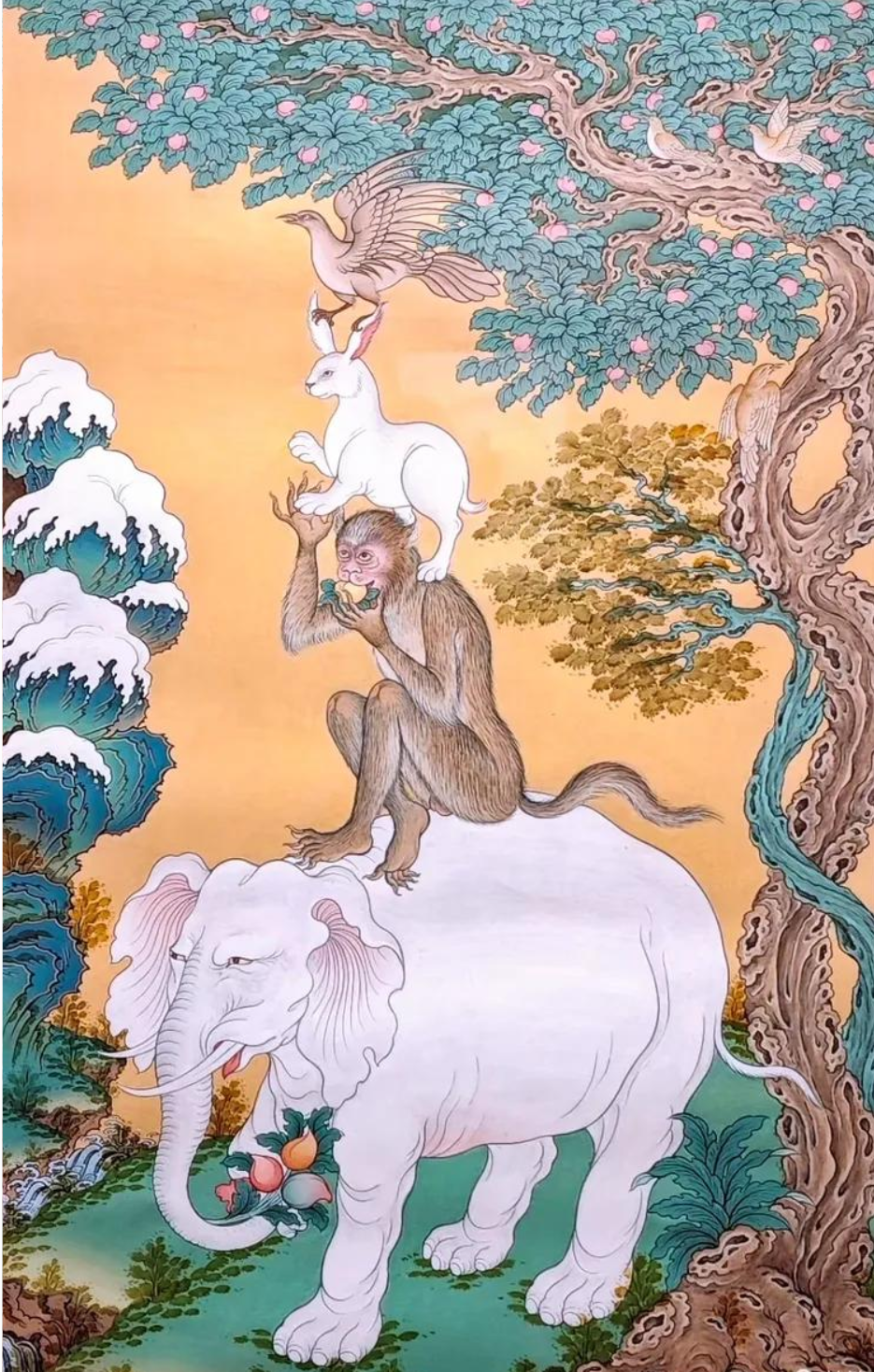
Ground floor, left wall — The Four Harmonious Brothers
Look at the painting on your left. At first glance it looks almost playful — like four animals balancing on top of each other. That impression is not wrong. But the picture is not about acrobatics. It is about the most practical piece of wisdom in Tibetan daily life.
At the bottom: an elephant. Solid, patient, enormous. On the elephant’s back: a monkey — agile, quick, clever. On the monkey’s back: a rabbit, small and light. And at the very top, standing on the rabbit: a tiny bird, a partridge, touching the highest branches.
This painting has a name: the Four Harmonious Brothers — Thuenpa Pungzhi in Tibetan. It is one of the most widely reproduced images in all of Tibetan art. You will find it in monasteries, in homes, printed on cloth and carved into stone all across the plateau. And yet the story behind it is almost never told in full.
The story: four animals, one tree, one lesson
In the forest, there was a great tree covered in sweet fruit. Four animals all wanted to eat from it: the elephant, the monkey, the rabbit, and the partridge. Each of them tried alone. Each of them failed.
The elephant was the strongest, the largest. But for all his power, he could not reach the fruit at the top of the tree. The monkey could climb and was quick on his feet, but he had nowhere stable to stand and could not hold his weight for long. The rabbit was light enough to go higher, but could not climb high enough on its own. And the partridge could fly to the very top — but had no place to land and rest while it picked the fruit.
So they talked it over. They came to an obvious conclusion: each of them had exactly the limitation the others could solve. Instead of competing — each trying alone and each going hungry — they agreed to work together. The elephant became the foundation, steady and immovable. The monkey stood on the elephant and reached higher. The rabbit climbed the monkey. The partridge took its place at the top and gathered the fruit from the highest branches that none of the others could reach alone.
Together, they picked everything. And then they shared it — equally. No hierarchy, no hoarding, no one animal claiming a larger portion because they had contributed more. Everyone gave what they could. Everyone received what they needed.
The Teaching
This is the meaning of the painting. Not acrobatics. Not a decorative image of animals. It is the oldest and most Tibetan way of saying: the strength of one person is limited. When you pool your differences, when each person contributes the thing they are good at, the result is something none of you could have reached alone.
There is no high or low in the painting. The elephant is at the bottom — but the elephant is not lesser than the bird. The bird is at the top — but the bird cannot do anything without the elephant. Each position is essential. Each contribution is equal. Unity, cooperation, shared reward — this is what the Tibetan people call the greatest fortune of a household, a village, a life.
Ground floor, right wall — The Wheel of Life
Now turn around. The mural on the right wall is a different kind of painting entirely — circular, dense, layered, and held in the claws of a terrifying figure. This is the Wheel of Life. The Wheel of Samsara. In Tibetan it is called Srid pa’i ‘khor lo . It is one of the most important images in all of Buddhist art, and this version — painted by the finest artists of mid-twentieth century Tibet — is among the most complete and detailed in existence.
The first thing every visitor notices is the figure holding the wheel. He is massive, dark, fanged — the King of Hell, Yama, the lord of death and judgment. He grips the entire wheel from behind, pressing it to his chest with his claws. His face looms over the top.
Why does Yama hold the wheel? The meaning is direct: every living being, across every lifetime, is held within the cycle of cause and consequence. You cannot step outside it simply by wishing to. You cannot negotiate your way out of it. Death and rebirth and the effects of everything you have done — Yama holds all of it, and he holds it tightly. No one is exempt.
The center: three animals, three poisons
The wheel is built in layers, and the explanation goes from the inside out.
At the very center — the hub from which everything else turns — are three animals drawn in a circle, each biting the tail of the next. A bird. A snake. A pig.
These three are not decorative. They are the three roots of all human suffering — what Buddhism calls the Three Poisons.
The bird represents greed — lobha . Desire without limit. The hunger that is never satisfied. The feeling that what you have is never enough, and that you always need more: more money, more recognition, more comfort, more love. The bird is always reaching for something just out of reach.
The snake represents anger — dvesha . The emotion that strikes, that poisons, that holds a grudge long after the original wound has healed. Hatred. Resentment. Jealousy. The snake does not forget.
The pig represents ignorance — moha . Not stupidity in the ordinary sense, but a deeper confusion: the inability to see things as they really are. Clinging to what is impermanent. Mistaking illusions for truth. Moving through life with your eyes open but your understanding closed.
Every difficulty you have ever experienced, every cycle you have found yourself repeating, every relationship that collapsed and rebuilt and collapsed again — Buddhist teaching says the root of all of it is these three: wanting too much, resenting too long, understanding too little.
The six realms — and the one way out
Moving outward from the center, the second ring of the wheel is divided into two halves — one white, one black, cleanly separated. The white half represents good action, good karma, the accumulated weight of a life lived with care and generosity. The black half represents harmful action, destructive karma, the accumulated weight of selfishness and cruelty. What you accumulate in this life determines which direction you travel in the next.
The outermost ring — the widest and most detailed — is divided into six sections. These are the Six Realms of existence, the destinations between which all living beings cycle according to their karma.
Three realms are considered fortunate: the god realm (heaven — beautiful, pleasurable, but impermanent); the human realm (our own realm — the one most suited to awakening, because humans have both suffering enough to motivate change and intelligence enough to act on it); and the asura realm (the realm of the demi-gods, beings of great power but consumed by jealousy and conflict).
Three realms are considered painful: the hell realm (intense suffering, the consequence of serious harmful action); the hungry ghost realm (beings consumed by insatiable hunger and thirst — an image for the experience of desire that can never be fulfilled); and the animal realm (existence without the capacity for ethical reflection — driven entirely by instinct and fear).
Around the very outermost edge of the wheel — a ring of small sequential images — are the Twelve Nidanas: the twelve links of dependent origination that describe the full arc of a life. Birth. Growth. Aging. Illness. Loss. Death. The chain of causes and consequences that makes one life lead to the next, and the next, without end.
The Teaching
Now look carefully at one last detail — the most important detail in the entire painting, and the one most visitors miss.
The Buddha is not inside the wheel. He stands to one side, outside the circle, pointing away from it.
This is the central message of the entire mural, and of Buddhist practice itself. The wheel is not a prison with no exit. The six realms are not an eternal sentence. The cycle of birth, suffering, death and rebirth is not a fixed fate. The Buddha stands outside it to show that liberation is possible — that by letting go of greed, by calming anger, by developing understanding, a person can step out of the cycle entirely.
This painting is not meant to frighten you. Many visitors feel its weight and think it is a warning about punishment. It is not. It is a map — showing you where you are, why you are there, and pointing clearly toward the door.
Now we go upstairs — 301 murals, Tibet’s history on a wall
These two paintings on the ground floor are the foundation. Everything upstairs is built on what they establish: the value of cooperation, the consequences of action, and the possibility of liberation.
The second floor of the New Palace contains the mural series I spent more time explaining than any other in my years of guiding in Lhasa. Three hundred and one individual paintings, arranged in sequence around the walls — a continuous visual narrative that begins with the origin of the Tibetan people and ends in living memory. There is nothing else like it in Tibet. There is nothing else like it in the world.
The murals were painted between 1954 and 1956 by the finest Tibetan artists of that generation. It took them more than two years. Every brushstroke is hand-done. Every scene was researched against historical and religious records. The result is what you are about to see: a complete history of Tibet, from its first mythological moment to the middle of the twentieth century, told entirely in paint.
The first mural is where we start. And the first mural begins before history — before Tibet existed as a nation, before the first king, before the first monastery. It begins with a monkey.
The first mural: how the Tibetan people came to be
Long ago, on the sacred mountain of Gongboiri in the Shannan region of southern Tibet, there lived a monkey who had been blessed and guided by the Bodhisattva Avalokitesvara — the Bodhisattva of Compassion. This monkey had renounced the ordinary life of the forest and spent his days in meditation, deep in the mountains, practicing the dharma.
In the same mountains lived a rock demoness — a powerful female spirit of the wilderness, ancient and fierce. She came to the monkey and asked to marry him. The monkey hesitated — he had taken vows of practice and solitude. He went to Avalokitesvara and asked what to do. The Bodhisattva told him: this union is auspicious. It serves all beings. Agree.
The monkey and the rock demoness were joined. In time, they had children — small monkeys, born of both the divine and the wild. The young ones multiplied. The mountain forest fed them for a while. Then the fruit ran short, and the tribe grew hungry.
Heaven took pity on the snowland’s beings. From the sky fell the five sacred grains — barley, wheat, rice, buckwheat, beans — settling across the high plateau. The monkeys ate grain instead of fruit. And eating grain, generation by generation, they changed.
The thick fur grew thinner and fell away. The tails shortened and disappeared. The posture straightened. The hands grew more capable. The mouth began to form words. Over many generations, instinct gave way to reason, animal nature gave way to human nature, and the descendants of the monkey and the rock demoness became the first people of the high plateau — the first Tibetans.
Where the memory of this story still lives
This is not only a religious myth told to explain a mystery. The geography of the story is precise and still verifiable today.
The city of Tsetang — the capital of Shannan Prefecture, one of Tibet’s oldest inhabited areas — takes its name directly from this story. In Tibetan, Tsetang means “the place where monkeys played.” The monkey cave on Gongboiri Mountain, where the sacred monkey lived in meditation, still stands. The site of Tibet’s first barley field — the place where the five sacred grains are said to have first taken root after falling from the sky — is still marked and visited.
When you stand in front of this first mural, you are looking at the Tibetan people’s account of where they came from. It is told in the language of myth — but it is anchored in a specific mountain, a specific valley, and a specific city whose name has carried the story in every syllable for more than a thousand years.
What the full 301 murals record
The monkey origin story is the opening frame. What follows across the remaining three hundred murals is the complete sweep of Tibetan history, told without gaps, from the first mythological king to the middle of the twentieth century.
The earliest panels show the descent of the first Tibetan king from the sky — the traditional account of the founding of the royal lineage — and the construction of Yumbulakhang, the first palace in Tibetan history, still standing in the Yarlung Valley.
Then comes the seventh century: Songtsen Gampo unifying the plateau, the arrival of Princess Wencheng from the Tang dynasty and Princess Bhrikuti from Nepal, the creation of the Tibetan written script, the founding of Jokhang Temple. Everything I told you at Jokhang is here on these walls — you can see it painted in the exact sequence in which we walked those streets.
The murals continue: Princess Jincheng’s arrival in Tibet. Guru Rinpoche’s coming and the founding of Samye Monastery — Tibet’s first complete Buddhist institution. The great persecution by Lang Darma. The recovery of Buddhism. The rise of the four major schools — Nyingma, Sakya, Kagyu, Gelug. The Yuan dynasty’s administration of Tibet through the Sakya lamas. The founding of the great Gelug monasteries. Tsongkhapa’s reform. The succession of Dalai Lamas, from the First through the Fourteenth.
The Ming dynasty’s relationship with Tibet. The Qing dynasty’s formal recognition of the Fifth Dalai Lama. The Qianlong Emperor and the Golden Urn system. The Gurkha invasion and its suppression. Three centuries of central government administration of Tibetan religious and civil affairs.
Every major event, every significant figure, every turning point in the political and religious history of the plateau across more than two thousand years — it is all here, in sequence, on these walls.
The final image — 1955, the last frame of Tibet’s thousand-year story
The mural sequence ends with a scene from living memory — recent enough that there are people still alive who were present for it.
The final painting shows the year 1955. Chairman Mao Zedong receives the Fourteenth Dalai Lama and the Tenth Panchen Lama in Zhongnanhai in Beijing. They are gathered to celebrate the Tibetan New Year together. The three figures — the leader of the People’s Republic and the two great living Buddhas of Tibetan Buddhism — are painted in the same visual language as the thangka paintings that have depicted Tibetan history for centuries.
It is a remarkable thing to stand in front of. Three hundred and one murals of Tibetan history, beginning with a monkey on a sacred mountain and ending with this meeting in Beijing. The oldest mythological time and the modern political reality, held together in a single continuous painting that wraps around the walls of one room in Lhasa.
This is what the New Palace of Norbulingka contains. Not a museum with labels and glass cases. A living visual document — the Tibetan people’s account of themselves, from the very beginning to the moment it was painted, still as vivid as the day the brushes were set down in 1956.
More stories from the same journey
The White Goats That Named a City
Jokhang Temple · Lhasa
Neither the Buddha Nor You
Potala Palace · Lhasa
The Two Great Lineages
Tashilhunpo Monastery · Shigatse
Frequently asked questions
What is Norbulingka?
Norbulingka is the summer palace of the Dalai Lamas in Lhasa, whose walls carry 301 murals recording Tibetan history.
What is the Wheel of Life?
The Wheel of Life is the Buddhist mural of the six realms and the one way out of them, explained here in front of the painting itself.
What are the Four Harmonious Brothers?
They are a well-known Buddhist image of cooperation — one of the stories told from the murals inside the summer palace.
Before you send your inquiry
- No deposit — ever. Your dates are held with a free inquiry, and nothing is due until we confirm. On fixed group departures, book early to secure your seats.
- Cancel free before your Tibet Travel Permit is issued — full refund, every dollar.
- After the permit is issued: the USD $100 permit fee is non-refundable, everything else is refunded. Refunds within 7 business days.
- Bring a group of 7 and your spot is free (7+1).
- Single room supplement — free of charge for any group booking 5 rooms or travelling with 10 or more.
- Tell us your dates and route on the form below — you will have a written itinerary and an item-by-item quote within 12 hours, with no obligation to book.
- Prices depend on group size, hotel standard, season and how you travel into Tibet, so we quote each trip individually rather than from a price list.
- Hotel details — the exact hotels we use — come with your quote. Ask below for the standard you would like and we will match it.
- A Lhasa-based Tibet tour operator since 1999 — our own guides, vehicles and office in Lhasa, 7,200+ travellers from 40+ countries, 4.9★ on TripAdvisor.
We answer within 12 hours, Monday to Saturday.